Saturday, 22 October 2011

County Hall, Westminster Bridge Road SE1

Untitled Group - said to be 'Benevolence and Humanity'
Sculpture commissioned by local authorities usually depicts either local history (such as Middlesex Guildhall or Wandsworth Town Hall) or aspirations like Social Justice, Welfare, Health etc (see Southwark Health Centre). Working in the aftermath of the First World War, Ernest Cole broke the rules so comprehensively in his work at County Hall that even his supporters found it difficult to classify or even identify his subjects.
Cole was already in trouble for failure to meet deadlines and his position on the County Hall team was in doubt.
The politicians were frankly bemused. In 1920 Alderman Cotton tabled a series of questions for debate, including "Are the figures unclothed as a protest against the monstrous price of clothes?...Do their positions, crowded on precarious perches outside the windows, indicate the lack of housing accommodation?"
The untitled group on Westminster Bridge Road attracted his particular ire: "The two muscular citizens have such despairing looks on their faces they appear to be preparing to hurl a bomb at the Houses of Parliament."
Cole never gave the group a title, but in the draft response to the Alderman's questions the management team called them 'Benevolence and Humanity'. They certainly don't look very benevolent, and the extraordinary globes they carry support writhing bodies in very odd attitudes. They do look a bit like ornate hand grenades.
The other group on the Westminster Bridge Road facade, 'World Beyond', is supposed to represent humanity supporting the world. Three shrugged, downward-looking, muscular men hold a globe surrounded by symbols of uncertain import. On top, a pair of bronze figures adopt painfully grotesque poses. For a symbol of a forward-looking local authority, it is deeply pessimistic.
Alderman Cotton never got his debate but the tide was clearly turning against Cole, who was later sacked. 
'World Beyond'

Friday, 21 October 2011

County Hall, Riverside Walk SE1

"River Thames" by Ernest Cole
County Hall was London's alternative parliament over the water. In the great war between right and left in the 1980s the Greater London Council under 'Red' Ken Livingstone set itself up in opposition to Prime Minister Margaret Thatcher, who responded by brutally executing it and ordering the building to be converted into tourist facilities, the political equivalent of planting the soil with salt.
The facades, however, remain just as they were, with a fascinating array of sculpture that tells a story of artistic ambition, personal frailty, political interference and furious debates over taste and aesthetics.
The building was designed as the home of the London County Council in 1908 by architect Ralph Knott, who chose a rising star of sculpture, Ernest Cole, to produce a series of aspiring figures for the main elevations. Cole was only 24, straight out of the South Kensington Art School, where his work had been noticed by Charles Ricketts and others. So commissioning him with a major sequence of works was a brave gamble.
"Creation of Eve" by Cole
Untitled Group by Cole
Construction started in 1912, so it was 1915 by the time Cole's sculptures were required. He started at a rush, completing five groups and most of a sixth in just 18 months despite having joined the army, which left only weekends for art. Most of the actual carving was done by his assistant Peter Induni.
At this point disaster struck. Cole was sent to the Western Front.
The artistic establishment was aghast that a talent of such promise was being put in harm's way and pressure was applied to transfer him to the much safer Intelligence Corps.
'Recreation' or 'Open Spaces' by Hardiman
In that capacity he was sent to America. On the way met a widowed lawyer called Laurie Manly and fell in love. Laurie decided Cole was a modern artistic genius ranking with Epstein and would devote her life to protecting his interests. Cole rejected his old friends such as Ricketts and struck out into abstract art. Ricketts said he had "gone over to the enemy."
After the war, Cole resumed work but he was a changed man. He had lost his drive and failed to meet deadlines, and he needed more money to cope with post-war inflation. Requests for extra payments were backed up by furious letters from his lawyer wife.
In nearly two years he finished the incomplete group and provided only one more, which he carved without having supplied Knott with a plaster maquette for approval. Knott rejected it as unsuitable.
A major row ensued. Members of the LCC were getting worried about the escalating costs and many dismissed Cole's completed works as incomprehensible modern rubbish. 
Knott counter-attacked by getting a group of luminaries including the poet and art critic Laurence Binyon (of We will Remember Them fame) to rally round in Cole's defence. For this, he was rewarded with a letter from Mrs Cole accusing him of having spent the war in safety in London drawing two salaries while her husband was defending his country.
By this time things had broken down irretrievably and the contract was terminated. The Coles retreated to a bungalow near Canterbury, rarely leaving except for a brief period at the beginning of the second world war when they were interned because of their open admiration for Mussolini and the Fascists.
To complete the project, Knott and the LCC brought in Alfred Hardiman, who was much easier to work with and whose images were more accessible for politicians and the public, as shown by the northernmost sculpture on the river frontage, 'Recreation'.

Tuesday, 11 October 2011

Colet Court, Hammersmith Road W6

John Colet was the Dean of St Pauls in the 16th century. A friend of Erasmus and a member of the reformist tendency in the Catholic Church, he founded St Paul's School and endowed it with a large part of the fortune he inherited from his City merchant father (he had no family - as an ordained priest he was celibate and all 21 of his siblings had died).
In the late 19th century the school had decamped to Hammersmith and was housed in a magnificent building by the great Alfred Waterhouse. The junior school, named after Colet despite the fact that it was actually founded by one Samuel Bewsher in 1881 was housed in a building across the road, designed in 1890 by architect W.H. Spaull of Oswestry. In 1968 the schools moved to their current campus in Barnes and the Waterhouse building was scandalously demolished except for the High Master's House. Colet Court was converted into offices.
A bust of the Dean is positioned at the centre of the facade, but for me the most charming part of the building is the skyline with its fancy Tudor chimneys and terracotta falcon.

Friday, 30 September 2011

French Protestant Church, Soho Square W1

The French Protestant Church in London was founded in 1550 when the child-king Edward VI, guided by Lord Protector Somerset, issued a charter establishing a strangers' church at the former Augustinian monastery in Austin Friars, in the City. The aim was to attract Protestant theologians and scholars experiencing persecution on the Continent.
Unfortunately, the congregation of all nations soon experienced the usual language difficulties and the Francophone faction decamped to Threadneedle Street.
The church was hugely boosted by the arrival in England of an estimated 50,000 Huguenots, exiled after the revocation of the Edict of Nantes in 1685. They brought with them many hugely valuable skills and the word refugee.
After a peripatetic period in Victorian times they built the current church in 1893 to the designs of Sir Aston Webb. Soho was chosen partly because of its strong expatriate French population (the House of Barnabas on the other corner of Soho Square was immortalised by Dickens as the house of Dr Manette in Tale of Two Cities).
To celebrate the quadricentennial of the charter in 1950, the tympanum of the entrance door was filled with a delightful carving by John Prangnell.
A boatload of Huguenots is shown docking at Dover, the helmsman waving and cheering at their successful escape from religious tyranny. Not all are happy, however - a pair of faces looks gloomily out of the cabin window, as if they have been horribly ill for the entire voyage.
The escaping Protestants face one more trial on their journey to religious freedom - that gangplank looks very precarious. A woman in clogs carries a spinning wheel, indicating the silk production that was a Huguenot speciality.
Inside Dover Castle, a pair of Huguenot leaders in 17th century dress are met by Edward VI in Tudor garb, signing his charter. It is a shameless mess of anachronisms.

Friday, 23 September 2011

123 Cannon Street EC4

Herbert Huntly-Gordon was an architect who decided to branch out into property development, that being the classic route to huge wealth.
He worked with Doulton to create a rough brown terracotta that would be hard-wearing, cheap and suitable for the free Renaissance-Tudor-Arts'n'Crafts style he favoured.
Right along the top of this block runs a a pair of of terracotta panels depicting charming little putti playing at work.
The chubby little chappies to the west (above) are importing and selling woollen cloth, carrying bales from boats and laying it out for a buyer who seems to be wearing nothing but a bag of money.
The panel on the west (below) shows a group of nudist potters making a terracotta urn and carving slabs of clay into ornamental panels. A kiln blazes merrily to the left, and a massive gear wheel indicates they are using steam power for the wheels.

Sunday, 18 September 2011

18-21 Northumberland Avenue WC2


Citadines Trafalgar Square is one of that curious new species of property speculation, the apart-hotel. The idea is that you buy a suite in it, so when you are in residence you get all the services of a top hotel and when you aren't they rent it out. Sounds like a recipe for the hotel to offload the capital risk onto investors and charge them an arm and a leg for services too - brilliant!
The building was created for a nobler purpose, as the headquarters of the Royal Commonwealth Society. Originally it was "a meeting place for gentlemen interested in colonial and Indian affairs" but has morphed into an educational charity. These days it perches in the Commonwealth Club along the road at No 25.
Built in 1934 to a dull design of Sir Herbert Baker, it features a pair of nude men supporting the balcony over the main entrance. These are much better, dynamic and forceful, the weight of the balcony held by the arms resting on the knees. Could they be pictures of Wheeler's favorite model, Tony Assirati?
As a bonus, the keystone over the door features a pair of merlions, mythical creatures that crop up in Etruscan and Indian art as well as Western heraldry. They appear in the arms of the East India Company and the cities of Great Yarmouth and Manilla.
In the 1960s the merlion was adopted as the symbol of the Singapore Tourist Board and nowadays it is protected by law in that country.
India and south east Asia are represented by the Star of India
with a lotus flower at its centre, Ceylon with an elephant and 
Burma with a peacock.  Baker did not list the Buddhist Stupa 
or the garlanded ox.
As well as the portal guardians by Sir Charles Wheeler, the former Royal Commonwealth Society building is decorated with six roundels containing emblems of its various peoples. At the time (1934) it was the Royal Empire Society, created to foster the idea of a new empire on Roman lines with citizenship available to all but the British at the top (naturally).
The symbolism is explained by the architect, Sir Herbert Baker, in a revealing article "Symbolic Constellation of the Empire", that he wrote for United Empire, the journal of the society. He discusses in detail a set of roundels in wood inside the building, which repeat most of the symbols on the facade.
In the absence of a full set of official heraldry, Baker had to make it up as he went along. He remarks dryly that if he had had to wait for the Colonial Office and the College of Arms the building would never be complete.
The roundels were carved by Joseph Armitage, who also worked with Baker on South Africa House and war graves in Flanders. The next year he would go on to design the National Trust's famous oak leaf symbol.
Canada is given a new symbol, a cross with maple leaves and maple seed pods in the middle, overlain with symbols of the main immigrant groups, the English, Scots, Irish and French. The natives don't get a look-in. The cod represent the Newfoundland fisheries, already under threat from over-fishing, and the full-rigged sailing ship is heading back from the West Indies.
Africa, with the stars of the Southern Cross. A winged springbok for South Africa. The source of the Nile is shown between what looks like the pyramids but in fact is intended to be Ptolemy's Mountains of the Moon. The soapstone birds are 'column sentinels' at Great Zimbabwe. Baker describes the heads as 'two types of natives, the more backward Negroid type and that with a blend of northern blood and civilization'. In 1934 racism was not just for Germans, clearly.
Britain includes England, Scotland, Wales and also Ireland, despite Ireland having been independent for more than ten years by the time the building was erected. The cross is for Malta and the rock is Gibraltar.
The Southern Cross (again) with a Wattle for Australia. The Palm Tree is for the islands of the Eastern Sea including Borneo, and the anchor is for the Naval Ports of Hong Kong and Singapore.
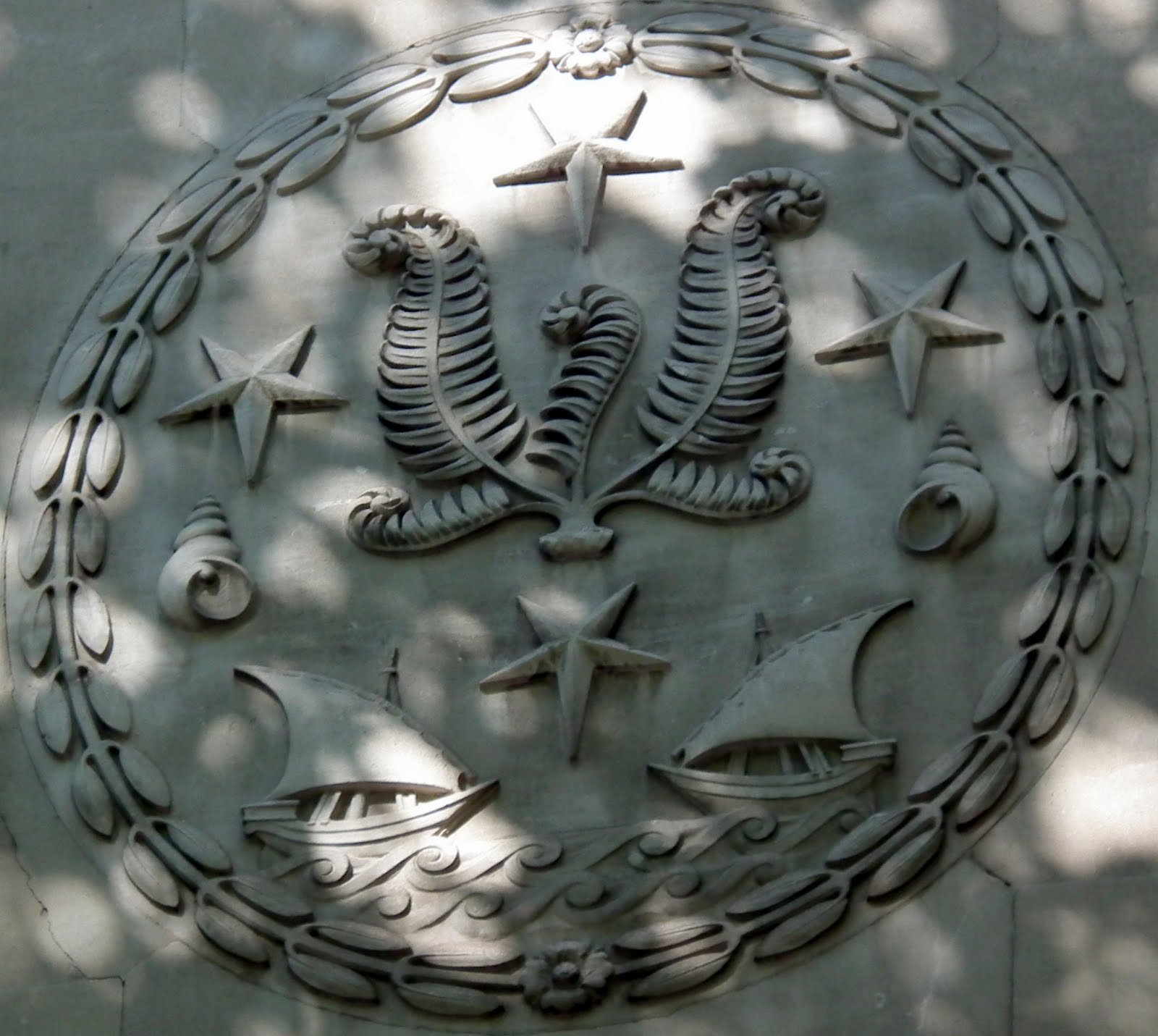
Oceania is represented by  the Southern Cross around the Silver Fern of New Zealand. The shells  and lateen-rigged boats are Polynesia and Melanesia.
Many thanks to Rachel Rowe, archivist of the RCS archive at Cambridge University, and Ruth Craggs, author of a very helpful article on the history of Commonwealth buildings.

Friday, 2 September 2011

Hammersmith Carnegie Library, Shepherds Bush Road W6

Hammersmith Library was built in 1905 by Henry Hare, an architect who specialised in municipal buildings.
The Free Style design has a central hall with pavilions at each end, lavishly decorated with allegorical sculpture by Frederick Schenk.
The right-hand pavilion has women representing literature and art. Literature has a book open on her lap, and sits next to a pile of tomes with a massive inkwell balanced rather precariously on top - an accident waiting to happen, I think. Art is sketching a Greek fragment - you can even see the outline on her pad.
The left-hand pavilion has a figure of Craft with a spinning wheel - note Schenk's signature.
Finally, Science (in a stroke of unconscious sexism, the only male figure) holds a pair of dividers. And I'm a bobtailed ptarmigan if those aren't the telescope and celestial globe that appear in Schenk's previous work at 37 Harley Street. Perhaps Schenk had a collection of science gear knocking around in his props cupboard for this sort of commission.
Graven images of the twin gods of English Culture, Milton and Shakespeare, are set up in the attic colonnade.
According to an academic paper, 'Free Classicism in the Edwardian library' by Clare Sherriff, the symbolism is highly significant: "Allied to the issue of freedom; the 'free' libraries were a political metaphor for the libertarian issues that dominated the period.
The race of nations and supremacy of empire created a political necessity for the libraries. Sculptural linguistics, such as Schenck's statues of Milton and Shakespeare at the Hammersmith library (1905) acted as semiotic bait. The Edwardian sculptor, often marginalised, is objectified by the research, which aims to map new meanings and connections to the Edwardian library."
So, all is clear.