Showing posts with label sir charles wheeler. Show all posts

Thursday, 14 June 2012

One New Change, EC4

One New Change is a classic example of City greed, a monster block right next to St Paul's. The trendy, look-at-me design by Jean Nouvel (based on an Airfix model of a stealth bomber) fails to conceal that fact that the main design objective is to cram as much lettable space as possible onto the site.
Not that the previous building was anything to write home about - a bland neo-Georgian block that was home to the Bank of England's accounts department. It was, however, decorated with a sprinkling of sculptures by some of Britain's most eminent artists including Sir Charles Wheeler, Donald Gilbert, David Evans and Ernest Gillick.
Most of the art was packed up and sold (though some is still available). But you can still see some of Wheeler's work on the roof terrace at One New Change.
And that was something of a revelation. You get to it by boarding a glass lift buried down a canyon through the building, with a stunning view of St Pauls at the end. When you get to the top, this is what you see:

Most people stay in the rather good tapas bar, but tucked around the corner is a 'vitrine' or glass case containing three of Wheeler's figures, St George Combatant, St George Triumphant and a Lion keystone. Not his best work, but infinitely better than Gavin Turk's new Nail, which is a big nail (duh!) sticking out of the pavement at the entrance.

Unfortunately, the glass is dotted to reduce heat transfer which makes the sculpture difficult to see properly, let alone photograph. My photo software also brings out the reflected blue of the sky much more strongly than it appears to the eye, but I rather like the effect.
Laid out on the compulsory sedum roof (oh so green) is one of the rather attractive mosaics by Boris Anrep.

Sunday, 4 March 2012

Tivoli Corner, Bank of England, Prince's Street EC2

The Bank of England is one of those buildings I try to avert my eyes from. The scandalous rebuilding in the 1920s and 30s was a grievous loss of the master-work of one of our greatest architects, Sir John Soane.
The perpetrator was Sir Herbert Baker, who kept most of Soane's curtain walls but added a lumpen office block above in his usual soft classical style.
Luckily, Baker employed his favourite sculptor, Sir Charles Wheeler, and his work is the building's only redeeming feature.
This gilded bronze figure of the Spirit of the Winds stands on the cupola of the Tivoli Corner. Despite being egregiously female, she is usually referred to as Ariel, something for which we have Baker to thank - he was the first to refer to her as an 'Arielesque figure'.
The Bank itself described her in heavyweight PR-speak as 'the symbol of the Dynamic Spirit of the Bank which carries Credit and Trust over the wide world.'

Under the rotunda of the Tivoli Corner, Wheeler placed these keystones representing the Roman port of London, Old Father Thames and an owl, presumably representing the wisdom for which bankers are famed.

Wednesday, 29 February 2012

Bank of England, Lothbury EC2


The back of the Bank of England, facing Lothbury, has four statues of females known locally as the Lothbury Ladies, carved by Sir Charles Wheeler in 1932-1937 for the rebuilt Bank.
The pair on the eastern pavillion stand in front of cornucopias and piles of money, repeating themes on the Threadneedle Street facade. Wheeler was slightly queasy about this, feeling that they sent the wrong signal at a time of financial crisis (Britain had just been forced off the gold standard).
He wrote to the architect, Sir Herbert Baker, who clearly told him not to be silly.
The current crisis shows that Wheeler was right to be sensitive about this - the image of the Bank pouring our money all over the City is one that is all too thought-provoking in these days of quantitative easing.
The Ladies on the western pavillion hold children, a boy and a girl. I am reminded by this of the weight of debt we have crippled our children with, but perhaps I should stop obsessing about how evil bankers are.


The last statue on the exterior of the Bank of England is a portrait of the architect of the previous building, Sir John Soane. 
It was commissioned at the suggestion of the architect of the replacement structure, Sir Herbert Baker. One would like to think that Baker wanted to make some sort of gesture of apology or atonement, but this seems unlikely as he was a pretty robust sort of man.

The figure is by Sir William Reid Dick. The great architect is shown wearing a full-length cloak and holding a bundle of drawings and a set square. The niche is decorated with the neo-Grecian motifs associated with his style.
The irony of placing a tribute to the architect actually on the sad ruins of his masterpiece was not lost on critics, especially as it is so close to Soane's much loved Tivoli Corner which Baker had promised to preserve but actually totally rebuilt. He is lucky to have his back turned to an act of vandalism more brutal than anything the Luftwaffe achieved. Indeed, nothing illustrates the Nazi's abysmal cultural values than that fact that the Bank was untouched in the blitz.

Sunday, 12 February 2012

Bank of England, Threadneedle Street EC2

The Bank of England was a masterpiece by one of Britain's greatest architects, Sir John Soane, which was scandalously destroyed in the 1930s.
The fact that Soane's fortress-like wall round the old building was preserved as a platform for the new only rubs salt into the wound. But Sir Herbert Baker's pompous neo-Georgian monstrosity is adorned with some of Sir Charles Wheeler's best work.
The pediment at the top frames the Lady of the Bank, the successor to a statue of Britannia that had inspired the Bank of England's nickname 'the Old Lady of Threadneedle Street'.
Charles Wheeler's dynamic figure of girl seated on the globe with her cape billowing behind and a shower of gold coins to one side emphasises the world-wide reach of the Bank. She holds a model of the Bank itself, like those medieval statues of bishops holding models of their cathedrals.
The statue was the subject of attacks from all quarters from the moment it was unveiled in 1930. The Evening Standard wrote:
"Miss Threadneedle Street is wearing a permanent wave and not a great deal else...[she] appears in the act of removing her bath-robe; but in place of the cake of soap that she should by rights be fondling she is dandling on her knee what looks like a small Greek temple. This may be her bath salts - they are put up very elaborately these days - or again it may be a toy savings bank...For the rest, the lady has a very hard eye, a disagreeable mouth, and hands only a shade less elephantiasic than Rima's own."
Notice how Epstein manages to get into every public row about sculpture, even when it is nothing to do with him? Rima was already 10 years old and it still rankled.
A group of stockholders waged a vigorous campaign against Wheeler's work, calling them 'very extraordinary monstrosities' but luckily got nowhere. 
The new Bank's main portico has a rusticated base with a big entrance arch that makes no sense because it opens onto the roof of Soane's old building.
On either side of the arch are six statues by Charles Wheeler, conventionally referred to as caryatids (female) and telemones (male), but they aren't really because caryatids and telemones have to support parts of a building on their heads and these don't. They are more like buttresses really.
The male figures represent custodianship, according to Herbert Baker's diaries. They carry chains, keys or banners. The women hold cornucopias, a great symbol of quantitative easing. That's our money they're pouring out all over a grateful City.
The three figures to the right of the central arch:
And those to the left:


Sunday, 18 September 2011

18-21 Northumberland Avenue WC2


Citadines Trafalgar Square is one of that curious new species of property speculation, the apart-hotel. The idea is that you buy a suite in it, so when you are in residence you get all the services of a top hotel and when you aren't they rent it out. Sounds like a recipe for the hotel to offload the capital risk onto investors and charge them an arm and a leg for services too - brilliant!
The building was created for a nobler purpose, as the headquarters of the Royal Commonwealth Society. Originally it was "a meeting place for gentlemen interested in colonial and Indian affairs" but has morphed into an educational charity. These days it perches in the Commonwealth Club along the road at No 25.
Built in 1934 to a dull design of Sir Herbert Baker, it features a pair of nude men supporting the balcony over the main entrance. These are much better, dynamic and forceful, the weight of the balcony held by the arms resting on the knees. Could they be pictures of Wheeler's favorite model, Tony Assirati?
As a bonus, the keystone over the door features a pair of merlions, mythical creatures that crop up in Etruscan and Indian art as well as Western heraldry. They appear in the arms of the East India Company and the cities of Great Yarmouth and Manilla.
In the 1960s the merlion was adopted as the symbol of the Singapore Tourist Board and nowadays it is protected by law in that country.
India and south east Asia are represented by the Star of India
with a lotus flower at its centre, Ceylon with an elephant and 
Burma with a peacock.  Baker did not list the Buddhist Stupa 
or the garlanded ox.
As well as the portal guardians by Sir Charles Wheeler, the former Royal Commonwealth Society building is decorated with six roundels containing emblems of its various peoples. At the time (1934) it was the Royal Empire Society, created to foster the idea of a new empire on Roman lines with citizenship available to all but the British at the top (naturally).
The symbolism is explained by the architect, Sir Herbert Baker, in a revealing article "Symbolic Constellation of the Empire", that he wrote for United Empire, the journal of the society. He discusses in detail a set of roundels in wood inside the building, which repeat most of the symbols on the facade.
In the absence of a full set of official heraldry, Baker had to make it up as he went along. He remarks dryly that if he had had to wait for the Colonial Office and the College of Arms the building would never be complete.
The roundels were carved by Joseph Armitage, who also worked with Baker on South Africa House and war graves in Flanders. The next year he would go on to design the National Trust's famous oak leaf symbol.
Canada is given a new symbol, a cross with maple leaves and maple seed pods in the middle, overlain with symbols of the main immigrant groups, the English, Scots, Irish and French. The natives don't get a look-in. The cod represent the Newfoundland fisheries, already under threat from over-fishing, and the full-rigged sailing ship is heading back from the West Indies.
Africa, with the stars of the Southern Cross. A winged springbok for South Africa. The source of the Nile is shown between what looks like the pyramids but in fact is intended to be Ptolemy's Mountains of the Moon. The soapstone birds are 'column sentinels' at Great Zimbabwe. Baker describes the heads as 'two types of natives, the more backward Negroid type and that with a blend of northern blood and civilization'. In 1934 racism was not just for Germans, clearly.
Britain includes England, Scotland, Wales and also Ireland, despite Ireland having been independent for more than ten years by the time the building was erected. The cross is for Malta and the rock is Gibraltar.
The Southern Cross (again) with a Wattle for Australia. The Palm Tree is for the islands of the Eastern Sea including Borneo, and the anchor is for the Naval Ports of Hong Kong and Singapore.
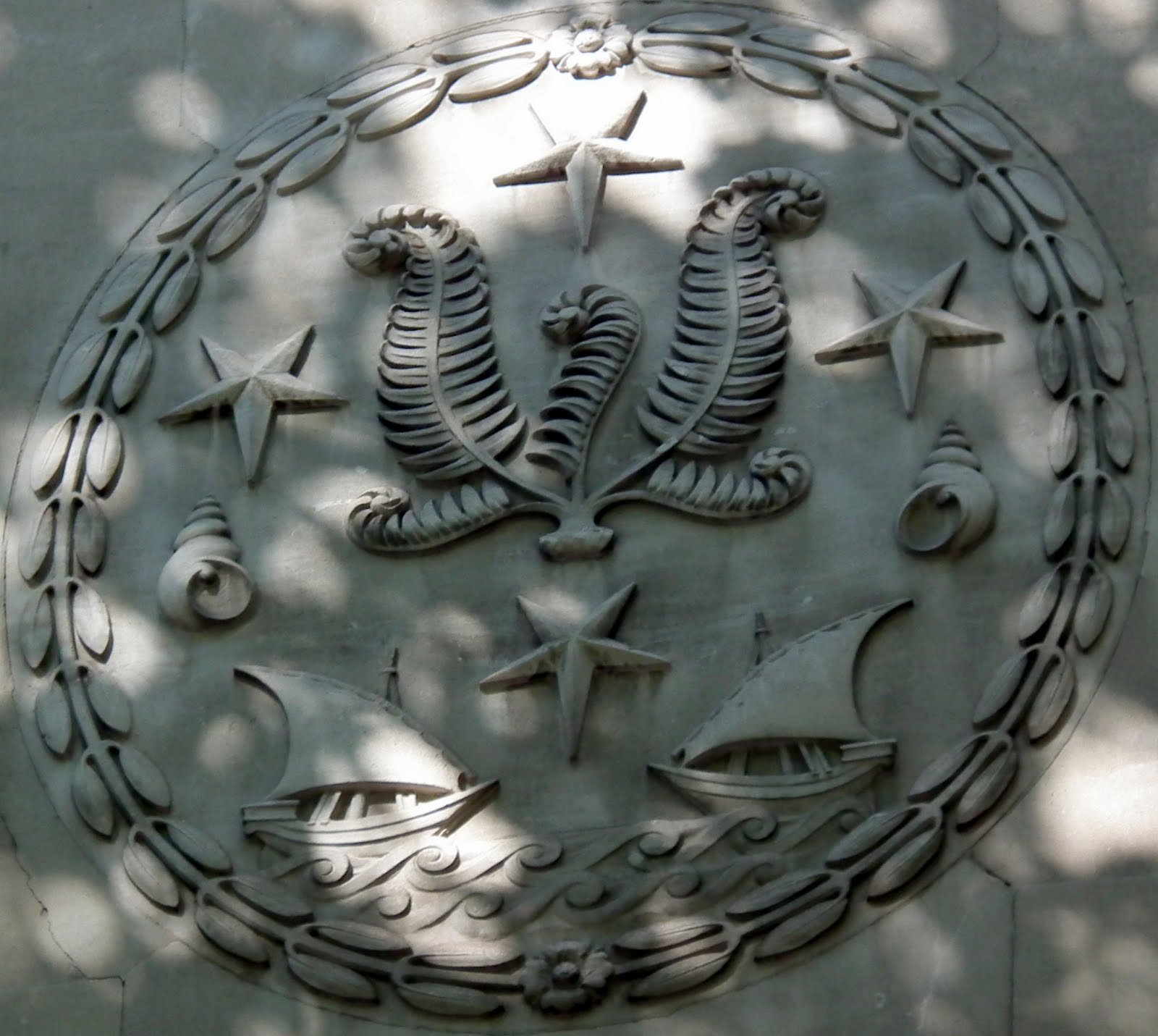
Oceania is represented by  the Southern Cross around the Silver Fern of New Zealand. The shells  and lateen-rigged boats are Polynesia and Melanesia.
Many thanks to Rachel Rowe, archivist of the RCS archive at Cambridge University, and Ruth Craggs, author of a very helpful article on the history of Commonwealth buildings.

Tuesday, 5 April 2011

Ministry of Defence, Horse Guards Avenue SW1

The vast bulk of the Ministry of Defence building was designed by Vincent Harris, originally for those ill-matched arms of government, the Department of Trade and the Air Ministry. It was built in phases from 1939 to 1959. The warriors moved in in the 1960s when the Ministry of Defence was created.
The main entrance is flanked by a pair of reclining giantesses symbolising Earth and Water, by Sir Charles Wheeler (1949). The figures weigh 40 tons each and don't look an ounce less. Despite their size, they have lovely pensive expressions.
A complementary pair, Fire and Air, were planned for the south entrance but the Treasury balked at the cost.
I don't think they are much of a loss - Earth and Water are differentiated only by sitting in waves or on the ground, so presumably the others would have had a bit of cloud and a few flames but otherwise more of the same.