Thursday, 19 August 2010

Thames House, Millbank SW1

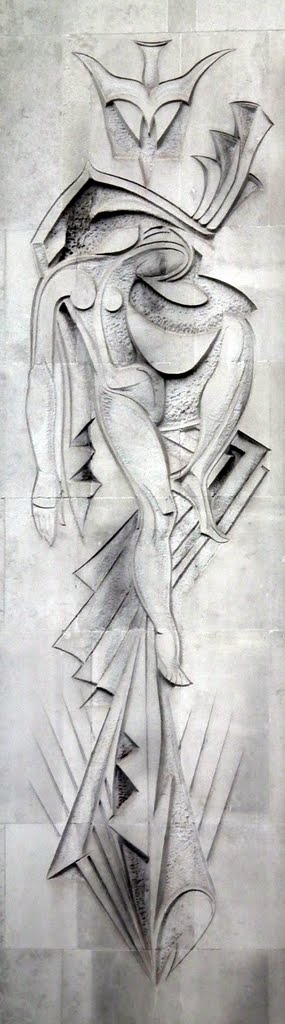
When the Security Service (better known as MI5 despite being renamed as far back as 1931) moved into the former ICI building just down the road from the Houses of Parliament they were lucky enough to inherit a couple of sculptures that are not only of the highest quality but also rather appropriate. Dating from 1928, they depict St George (left) and Britannia (right) and are by Charles Sargeant Jagger MC.
St George is difficult to interpret. His sword stands point-down in front of him, surrounded by supplicating figures. He holds an amorphous object - the dragon's head?
Britannia also has a sword and supplicating figures, and seems to be holding chests of some sort. The profits of sea-borne trade?
The keystone of the arch above (which used to span Paige Street until the building was converted for the spooks) is equally mysterious. The bearded figure looks like Old Father Thames but is blindfold and holds the sword and scales of Justice.
Most oddly, the balance has the Monarch's crown on one side and a working man's flat cap on the other.
Frankly, the symbolism eludes me.


It doesn't seem to be known who did the other sculptures on Thames House, but they are not nearly craggy enough for Jagger.
The keystone over the visitors' entrance is indisputably Old Father Thames (again), wearing a shell with dolphins on his head. On either side spreads boating paraphenalia including sails, oars, boathooks, lifebelts and mooring chains. The swags of flowers presumably symbolise the prosperity the river brought to London.
The final keystone is a rather lovely girl with her long tresses knotted under her chin and wearing a scallop shell coronet. Bet she has a fishtail where her legs ought to be.

Sunday, 8 August 2010

Methodist Missionary Society, Marylebone Road NW1

The trees along Marylebone Road are very nice and all that but they make photographing the sculpture jolly difficult. I think I will have to come back in the winter to retake these excellent works by David Evans on the Methodist Missionary Society building of 1939, designed by Paul Manger, A.J. May and L. Sylvester Sullivan.
The low relief over the front door shows Christ signing up the fishermen Simon, Andrew, James and John as disciples, telling them he will make them 'fishers of men'. Mind you, they seem to have had a very successful time as fishers of fish, judging by the number of heads peeking out from the stern of the boat. Perhaps it is a hint at the miraculous draft of fishes, Christ's first miracle after the resurrection.
High up on the side of the building are three fine portraits, one of a nurse cradling a baby, the others of African and Indian converts.


Monday, 2 August 2010

Ferguson House, 15 Marylebone Road NW1


This self-effacing 1957 office block stands on the site of one of Charles Dickens's favourite houses which he occupied from 1839 to 1851.
A huge panel sculpted by Estcourt J Clack (known as Jim) commemorates some of the characters the great man created there.
Top left is Jacob Marley appearing unto Scrooge in the form of a door knocker in A Christmas Carol.
Next is Barnaby Rudge and his raven Grip. Dickens actually had a pet raven called Grip at the house - when it died he had him stuffed and mounted.
Top right are Little Nell and her pathetic grandfather from The Old Curiosity Shop, above Paul Dombey (another inadequate parent) and his daughter Florence from Dombey and Son.
One of my favourite characters, midwife and 'layer-out' Sairey Gamp from Martin Chuzzlewit is to the middle right and Mr Micawber with David Copperfield is at the bottom.

Friday, 30 July 2010

Former Woolworth HQ, Marylebone Road NW1

Woolworth's UK headquarters is a dull building by that very dull architect, Colonel Seifert. In 1955 it was believed that covering the front with stone made any building great.
It is made memorable by decorative work by Bainbridge Copnall.
To find out more, I asked Paul Seaton, long-time Woolworths employee and author of A Sixpenny Romance, a history of the store.
Paul very kindly emailed some of Copnall's own words about the Woolworth sculpture. His description of the group over the main entrance reads:
"A group over the Canopy descriptive of Oversea's (sic) Trade, symbolising a Mariner holding the globe in his hand on which he is pointing out the position of Woolworths throughout the world to a man and woman on either side of him. The male figure has his left hand on a full sack of Good Fruits."

The most prominent item is a heraldic-looking panel on the penthouse floor at the top of the facade. Copnall restates Woolworth's 'Diamond W' trademark...
"...in the form of a square, depicting the 'W' for Woolworths surmounting a Cornucopia of Plenty, superimposed on a background of Sea, Ground and Air; held by Supporters depicting Male and Female holding up the main mast and flagpole from the ship Mayflower symbolising the Trade Fellowship between the U.S.A. and Britain; the whole mounted on the Dove of Peace under which radiates from the centre - Rays of Gold. The whole work was modelled in a manner to enable squares of mosaic to catch the sun and glitter as in a precious jewel....The work was applied to the stone with phosphor bronze corbels, and weighed approximately 1.25 tons. It took about three months to make and was built entirely from my full size drawings."
The edges of the building on either side of the facade were decorated with intaglio figures, which Copnall describes as follows:
"Two incised carvings on the sides and base of the building. They depict the Sunrise and Sunset, symbolising the full day of activity in the building; these are carved direct into the stone from full size drawings; automatic hammers were used throughout. This is a new technique for carvings and they will continue to read stronger and stronger as the years progress." 

Wednesday, 28 July 2010

42-46 Wigmore Street W1

This pair of very relaxed putti is above the central arch of an 1882 shop designed by George & Peto in the Dutch style, in red brick with terracotta facings and a line of frilly gables on top. The site was the original Debenhams, but I have been unable to find out if this building was built for the plutocratic draper which in any event moved over the road in 1907.

Friday, 16 July 2010

Victoria Palace Theatre, Victoria Street SW1


I have been given a great advance birthday present - a Fujifilm Finepix HS10 with a 30x zoom.
This brings even the most skyward sculpture within range. To give an idea, here is yet another pic of the statue of Pavlova on the Victoria Palace, which is the highest statue I can see as I emerge from the station. Unfortunately, the day was grey and threatening rain so quality is not as good as it might be.
The statues at the base of the cupola are made of Gibbs & Canning's white faience, so it is probable they were created by the company's chief modeller John Evans.
The one on the left holds a cornucopia o'erflowing with fruit'n'veg, and points upward to the prima ballerina. The one on the right brandishes a palm in her right hand and holds a lute rather awkwardly with her left, strumming with her thumb.

Friday, 9 July 2010

Stanford, 12-14 Long Acre WC2

Stanford was Mecca for explorers, empire-builders and travelling salesmen, supplying maps of the world when a third of it was coloured pink. Now it sells Rough Guides to backpackers, but its Flemish renaissance style headquarters still has plenty of Victorian confidence and panache.
It was designed in 1900 by Read & Macdonald, who covered plots all over Mayfair with similar items.
The name over the door is flanked by map-making impedimenta - a pair of compasses on the left and pens and ink on the right.
The first-floor panel had the royal arms (Stanford was By Royal Appointment) and the arms of their principal suppliers - on the left the Board of Ordnance, on the right the Hydrographer of the Navy.