Showing posts with label bainbridge copnall. Show all posts

Saturday, 6 September 2014

St Paul's Churchyard EC4

Becket depicts the Archbishop in the agony of death, his right hand extended as if to ward off the blows of his knightly assassins. The plinth is stepped to recall the steps into the choir of Canterbury Cathedral.
This memorable image was created in 1970 as part of the commemorations of the saint's martyrdom by Bainbridge Copnall, who was living near Canterbury at the time. It is rather unclear why it was not bought for Canterbury but ended up next to St Pauls in 1973.
The material looks like bronze but is in fact resin coloured to look like bronze, a process pioneered by Copnall himself.
Unfortunately, the weakness of the material was exposed in the hurricane of 1987 when a cherry tree fell on it and did considerable damage. Luckily, a former student of Copnall's, Patrick Crouch, was able to restore it.

Friday, 16 May 2014

Vue West End Cinema, Cranbourn Street WC2

The flamboyantly Art Deco facade of the Vue Cinema dates back to 1938 when it was built as the Warner Theatre by architects Thomas Somerford and E.A. Stone.
At the top corners are figures representing Sight and Sound by E. Bainbridge Copnall, who creates a kind of 'motion sculpture' with successive images to create an impression of movement in the same way the movies shown inside the theatre use successive frames.

Thursday, 14 April 2011

262 High Holborn

The relief on the modernist office block at 262 High Holborn has been described as everything from a vision of the Book of Revelation or Celtic imagery to 'hallucinogenic doodling'.
In fact, it is the heraldry of the Pearl Assurance Company, who built it in 1956, and was the creation of Bainbridge Copnall. The architects were T.P. Bennett and Son, who occupied it themselves for many years.
At the top is St Margaret of Antioch, whose name in Latin, Margarita, means pearl. She holds a gigantic pearl in her right hand and the martyr's palm in her left - she was devoured by Satan in the form of a dragon, who lies beneath her feet looking a bit grumpy.
The other symbols relate to places associated with Pearl Assurance. The swords are the City of London, and the covered cup is St Dunstan, the patron saint of Stepney where the company had its first office. The wounded hind is St Giles, of St Giles in the Fields, the local parish.
Other symbols are the sun and a star, and the elements, air, fire and water.
The artist has not included Pearl Assurance's motto, Damus Plus Quam Pollicemur (We give more than we promise), which is a shame because then I could have given you a poem written by some unsung South African employee way back:
Upon the dragon's back for years
St Margaret bravely hid her fears.
A most precarious place to stand
And hold a pearl in outstretched hand.
But Margaret has no need to worry
For if she jumps off in a hurry,
And slips perchance and breaks a femur -
DAMUS PLUS QUAM POLLICEMUR.

Many thanks to Jo French, information manager at T.P. Bennett, who dug out this information.

Friday, 30 July 2010

Former Woolworth HQ, Marylebone Road NW1

Woolworth's UK headquarters is a dull building by that very dull architect, Colonel Seifert. In 1955 it was believed that covering the front with stone made any building great.
It is made memorable by decorative work by Bainbridge Copnall.
To find out more, I asked Paul Seaton, long-time Woolworths employee and author of A Sixpenny Romance, a history of the store.
Paul very kindly emailed some of Copnall's own words about the Woolworth sculpture. His description of the group over the main entrance reads:
"A group over the Canopy descriptive of Oversea's (sic) Trade, symbolising a Mariner holding the globe in his hand on which he is pointing out the position of Woolworths throughout the world to a man and woman on either side of him. The male figure has his left hand on a full sack of Good Fruits."

The most prominent item is a heraldic-looking panel on the penthouse floor at the top of the facade. Copnall restates Woolworth's 'Diamond W' trademark...
"...in the form of a square, depicting the 'W' for Woolworths surmounting a Cornucopia of Plenty, superimposed on a background of Sea, Ground and Air; held by Supporters depicting Male and Female holding up the main mast and flagpole from the ship Mayflower symbolising the Trade Fellowship between the U.S.A. and Britain; the whole mounted on the Dove of Peace under which radiates from the centre - Rays of Gold. The whole work was modelled in a manner to enable squares of mosaic to catch the sun and glitter as in a precious jewel....The work was applied to the stone with phosphor bronze corbels, and weighed approximately 1.25 tons. It took about three months to make and was built entirely from my full size drawings."
The edges of the building on either side of the facade were decorated with intaglio figures, which Copnall describes as follows:
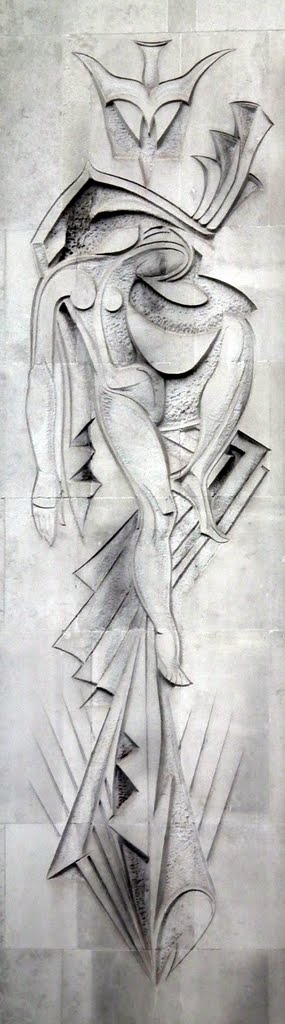
"Two incised carvings on the sides and base of the building. They depict the Sunrise and Sunset, symbolising the full day of activity in the building; these are carved direct into the stone from full size drawings; automatic hammers were used throughout. This is a new technique for carvings and they will continue to read stronger and stronger as the years progress." 

Sunday, 14 February 2010

Royal Institute of British Architects, Portland Place W1

Wren
The side elevation of the RIBA on Weymouth Street is enlivened by Sir Christopher Wren surrounded by representative figures of the Artisan, the Painter, the Sculptor and the Mechanic. They were carved by Bainbridge Copnall.
The Artisan


The Painter
The arrangement is an unconscious revelation of the way architecture works.
The Great Man is surrounded by his backup team, unnamed even when they are great artists in their own right. This has got out of hand recently, with 'starchitects' hogging the media with their team lost in obscurity.
The Mechanic
The Sculptor


Funnily enough, though, Wren himself has been suffering from the reverse effect recently with a nasty tendency for attention-seeking critics to claim that his assistant Hawksmoor was a finer architect but has been ignored by history because of his working class origins. This is pure snobbery, enabling the critic to show his superior taste by dismissing the architect everyone knows in favour of one that a tiny minority has even heard of. And it is nonsense.

Friday, 12 February 2010

Royal Institute of British Architects, Portland Place W1

The figure at the centre of the RIBA's Portland Place facade is Architectural Aspiration, by E. Bainbridge Copnal. The Architect stands in a model village with specimens of Western styles of architecture, from ancient Greek through Renaissance classical to Gothic. He looks up, shielding his eyes, looking at some magnficent dome.
Copnal also did the figures round the side, of which more anon.

Wednesday, 1 July 2009

Lambeth Mission, Lambeth Road SE1

The Lambeth Mission was set up by the first Methodists, converted by John Wesley himself when he preached at Kennington Common. Between the wars it was made famous by the energetic and forward-looking minister Thomas Tiplady, author of such hymns as "Above the hills of time the cross is gleaming."
Tiplady wanted to harness the new medium of film to the cause, and collaborated with a Methodist lay preacher called J. Arthur Rank to produce wholesome films with a Christian message which were shown at the Mission.
In 1945 the chapel was hit by a V2 and was rebuilt in 1950. The architect was Alec Gavin, and Tiplady also commissioned Bainbridge Copnall to provide a monumental sculpture for the front.
Copnall was headmaster of the Sir John Cass Institute of Arts and Crafts at the time, and had been scouring London's bomb sites for nice bits of stone. It is fitting that debris from the hell that was the blitz should be used to create this uplifting and optimistic piece.
Officially called The Word, it is better known as The Lambeth Street Preacher. The minister points heavenward, while a couple at his feet hold their child up to clasp the Bible in his hand.
Copnall was not very happy with the final work, as he wanted it to have a rough finish and to stand free in its niche. The architect insisted that it be given a high finish and for it to be enclosed in a brick surround.
Of course, Copnall could not possibly have predicted that many years later his street preacher would look just as if he was calling heaven on a mobile phone.