Monday, 23 December 2013

West India Avenue, Canary Wharf E14

Giles Penny is a painter-turned-sculptor who produces a lot of corporate art - you will find his work at headquarters buildings, apartment blocks and shopping malls around the country.
Man with Arms Open is typical, a human figure reduced to a pose, but a flamboyant, good humoured pose. It was erected in 1999.

Saturday, 21 December 2013

Columbia Courtyard, Canary Wharf E14

We tend to think of the statue of Ozymandias as just the legs, but Shelley mentions his face too:
Half sunk, a shattered visage lies, whose frown,
And wrinkled lip, and sneer of cold command,
Tell that its sculptor well those passions read
Centurione I by Polish sculptor Igor Mitoraj could just be that shattered visage, though he doesn't have a sneer of cold command, more an expression of slight regret.
Researching this, I discovered to my delight that Shelley's famous sonnet was the outcome of a sonnet-writing contest with his friend, a novelist, parodist, poet and stockbrocker called Horace Smith. Smith's sonnet concludes with a very pertinent warning, considering the current surroundings of Centurione I:
We wonder,—and some Hunter may express
Wonder like ours, when thro' the wilderness
Where London stood, holding the Wolf in chace,
He meets some fragment huge, and stops to guess
What powerful but unrecorded race
Once dwelt in that annihilated place.

Wednesday, 18 December 2013

Wellington Monument, Hyde Park, W1

The colossal figure of Achilles (18ft high) was erected in 1822 to "Arthur Duke of Wellington and his brave companions in arms", funded by a subscriptions from women. It was made by Richard Westmacott (later Sir Richard), who cast the statue in his own foundry at Pimlico from cannon captured in various of Wellington's campaigns.
Although it was based on impeccable classical precedents including the Borghese Gladiator and the Quirinal Horse Tamers, and the Iron Duke's gentlemanly attributes were modestly covered with a fig leaf, it was London's first nude sculpture and caused a bit of a ruckus. Critics also hated the implication that Wellington was some sort of superhero.
George Cruikshank was particularly savage, publishing a satirical print entitled Backside & front view of the ladies fancy-man, Paddy Carey, The line at the top reads: "This Brazen Image was erected by the Ladies, in honor of Paddy Carey O' Killus, Esq. their Man O'Metal!!!"
The statue wears Wellington boots, and the man himself is shown looking on, sticking his bum out like the statue. 

Tuesday, 3 December 2013

The Princess Royal Nurses Home, Guilford Street WC1

The Hospital for Sick Children in Great Ormond Street was largely rebuilt by architects Hall, Easton and Robertson in the 1930s, starting with the nurses' home in 1933.
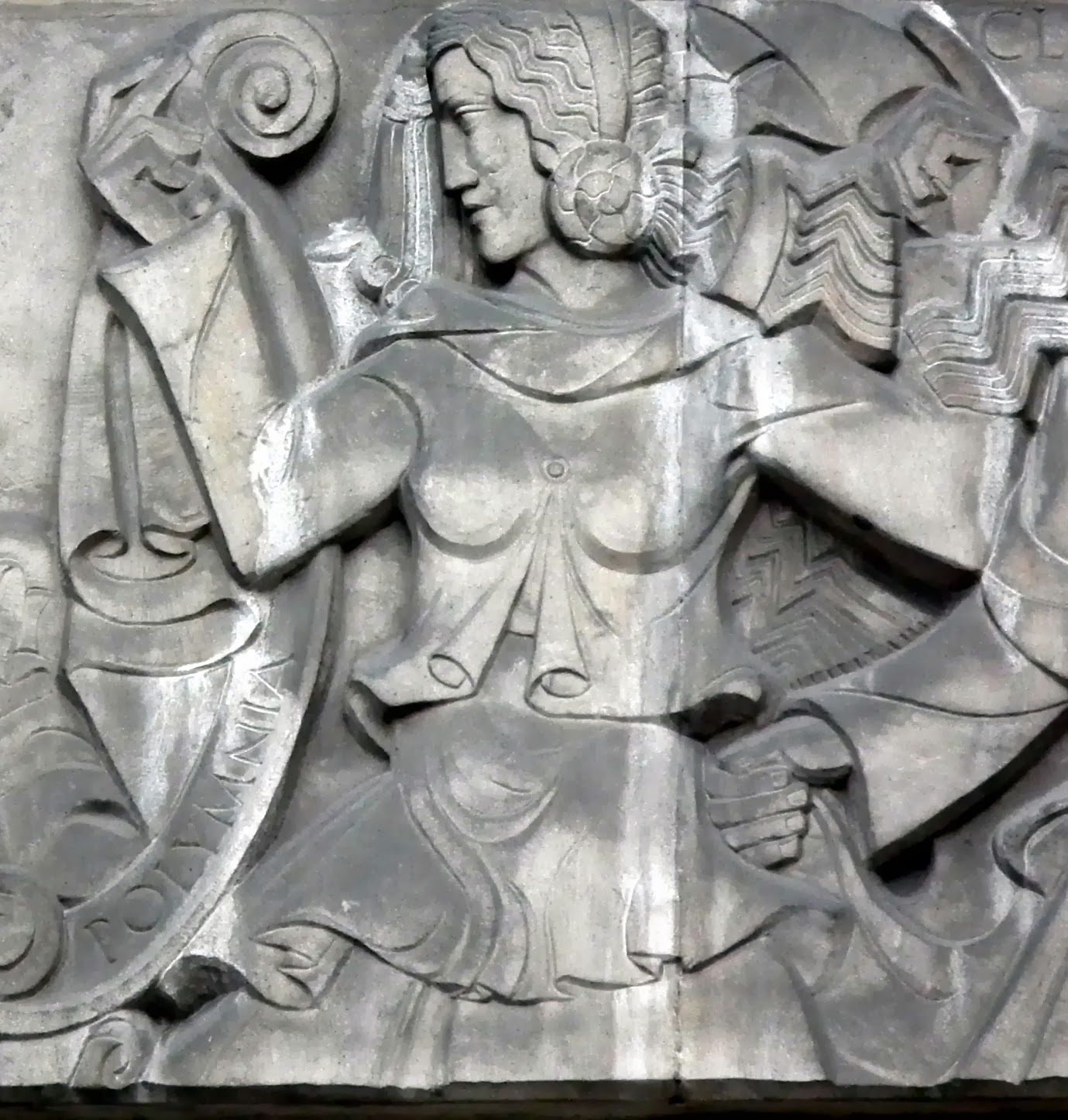
Over the doorway, Eric Aumonier created a bas relief sculpture of Hygeia flanked by the nine muses.
Hygiea was the daughter of Asclepius, the demi-god of medicine, and she is almost invariably depicted feeding her father's wise snake from a bowl of healing balm.
Eric Aumonier came from a dynasty of architectural sculptors founded by his grandfather William. He studied at the Central School of Arts and Crafts and initially joined the family firm but left in the lat 1920s to strike out on his own. His work starts in the Art Deco but by the 1950s had become much more International Modern.
(Thanks to Nick Baldwin, archivist at Great Ormond Street Hospital, and Peter Kent of the RIBA Library for their help).
The Muses, from left to right:

Melpomene, Muse of Tragedy, with the Mask of Tragedy.

Polymnia, Muse of Hymnody. "Polymnia, nursingmother of the dance, waved her arms, and sketched in the air an image of a soundless voice, speaking with hands and moving eyes in a graphic picture of silence full of meaning." (Dionysiaca)

Clio, Muse of History, clutching a scroll.

Erato, Muse of Lyric Poetry, including love poems. Often shown with a lyre - is that a lyre behind her and to her right?

Urania, Muse of Astronomy and Universal Love, holding her rod and celestial globe.

Calliope, Muse of Epic Poetry and Homer's inspiration. She is usually depicted with a writing tablet but here seems to be holding a staff or musical instrument.

Terpsichore, Muse of Dance. Usually shown sitting down, accompanying the dancers on the lyre, but here shown joyously dancing herself.

Euterpe, Muse of Music. Usually shown with a double flute but Aumonier depicts her with cymbals.

Thalia, Muse of Comedy and Idyllic Poetry. The happy one, with the mask of comedy.

Friday, 29 November 2013

143 Fleet Street EC4

Mary Queen of Scots House was built in 1905 for a Scottish insurance company. The statue was the idea of one of the developers, Sir John Tollemache Sinclair, Bart, MP, who was a big fan of the ill-fated lady.
The architect was one R.M. Roe, who concocted a facade as frilly as a doily with lashings of French Flamboyant tracery. Sadly, the carver of the statue is unknown.
The image seems to be the only outside memorial of Mary, which lead to recent demands for a statue to be erected in Scotland. Ironically, it stands just along the road from a figure of her nemesis, Elizabeth I.

Sunday, 24 November 2013

Union Street SE1

When he was just 12 years old, Charles Dickens had to go to work in a blacking factory because his father had been imprisoned in the Marshalsea for debt. His route home from work took him over Blackfriars Bridge into Southwark "down that turning in the Blackfriars Road which has Rowland Hill’s chapel on one side, and the likeness of a golden dog licking a golden pot over a shop door on the other," as he wrote in his autobiography.
The original dog was made of pine with an iron pot. The shop was an ironmonger selling, among other things, kitchen items such as pots, pans and everything needed to build a fire, including cast iron firebacks and the wrought iron supports for the logs, known as fire dogs. So the sign is a bit of a rebus or architectural pun.
The ironmongers also used the design on its range of 'coal plates', the circular cast iron covers for the chutes that punctuated all Victorian pavements, allowing the coal men to pour their loads directly into coal cellars in front of every house.
Dickens made the sign famous, so when the shop was demolished in 1932 it was taken to the Cuming Museum. To celebrate his bicentenary in 2013, a replica carved in elm by Mike Painter was erected on the original site. Trendily, the sign has its own Twitter feed.

Tuesday, 19 November 2013

61 Kings Cross Road WC1

This oddity seems to be all that is left of Bagnigge House, in the 17th century the country home, it is said, of Nell Gwynne. It became resort for Londoners, later becoming famous as Bagnigge Wells when mineral springs were discovered, where "both the chalybeate and purging waters are in the greatest perfection ever known, and may be drank at 3d. each person, or delivered at the pump-room at 8d. per gallon. They are recommended by the most eminent physicians for various disorders," as the proprietor bragged.
Bagnigge House was next to the "Pinder a Wakefield", a famous inn. A pinder was the keeper of a pound where stray animals were held, and the Pinder of Wakefield was the truculent hero who bested Robin Hood, Will Scarlet and Little John in a sword fight.
The place declined sadly in Victorian times and was built over in the 1850s. The plaque used to stand on a garden entrance.