Over the doorway, Eric Aumonier created a bas relief sculpture of Hygeia flanked by the nine muses.
Hygiea was the daughter of Asclepius, the demi-god of medicine, and she is almost invariably depicted feeding her father's wise snake from a bowl of healing balm.
Eric Aumonier came from a dynasty of architectural sculptors founded by his grandfather William. He studied at the Central School of Arts and Crafts and initially joined the family firm but left in the lat 1920s to strike out on his own. His work starts in the Art Deco but by the 1950s had become much more International Modern.
(Thanks to Nick Baldwin, archivist at Great Ormond Street Hospital, and Peter Kent of the RIBA Library for their help).

The Muses, from left to right:

Melpomene, Muse of Tragedy, with the Mask of Tragedy.
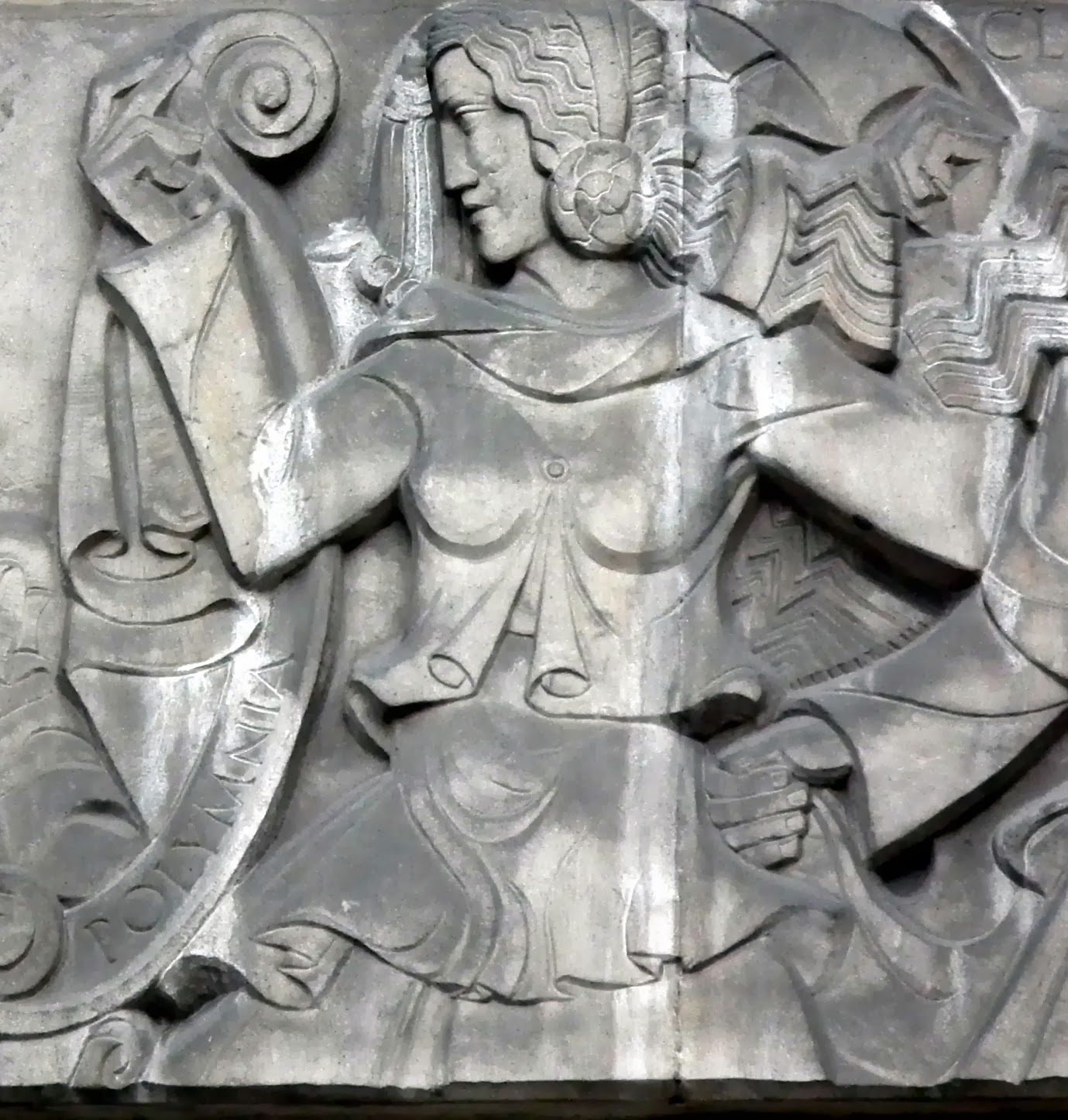
Polymnia, Muse of Hymnody. "Polymnia, nursingmother of the dance, waved her arms, and sketched in the air an image of a soundless voice, speaking with hands and moving eyes in a graphic picture of silence full of meaning." (Dionysiaca)

Clio, Muse of History, clutching a scroll.

Erato, Muse of Lyric Poetry, including love poems. Often shown with a lyre - is that a lyre behind her and to her right?

Urania, Muse of Astronomy and Universal Love, holding her rod and celestial globe.

Calliope, Muse of Epic Poetry and Homer's inspiration. She is usually depicted with a writing tablet but here seems to be holding a staff or musical instrument.

Terpsichore, Muse of Dance. Usually shown sitting down, accompanying the dancers on the lyre, but here shown joyously dancing herself.

Euterpe, Muse of Music. Usually shown with a double flute but Aumonier depicts her with cymbals.

Thalia, Muse of Comedy and Idyllic Poetry. The happy one, with the mask of comedy.