Thursday, 7 November 2013

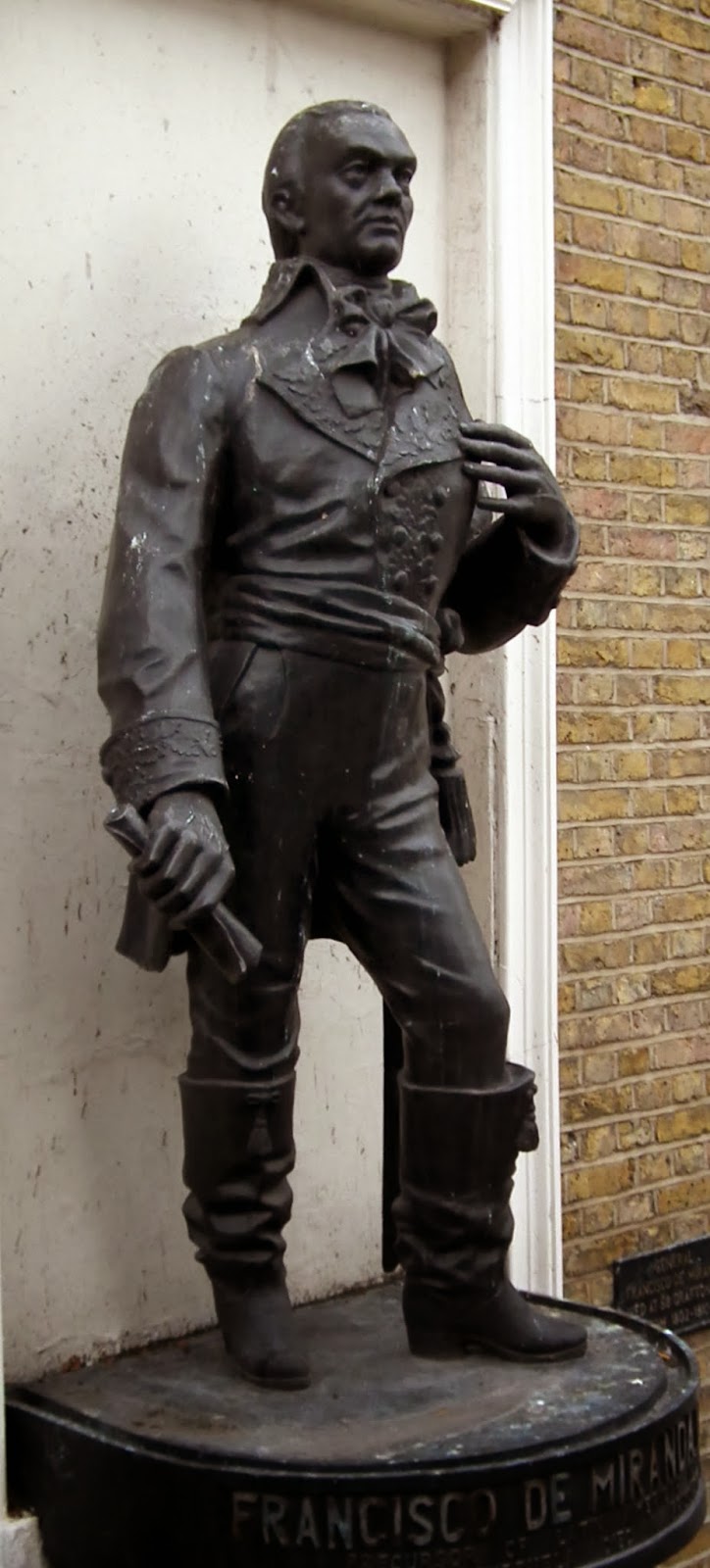
58 Grafton Way W1

The Venezualan patriot Francisco de Miranda lived at 58 Grafton Way from 1802 to 1810, during which time it became a hotbed of South American revolutionary fervour where all the famous names from Bolivar down met and plotted.
In 1810 Miranda returned to Venezuala and became its first revolutionary leader, only to be deposed by a Spanish counter-attack. On his way to be evacuated by a British warship he was handed over to the Spanish authorities by, ironically, Bolivar. Miranda died in prison a few years later.
The statue is a copy of one made in 1895 by the Venezualan sculptor Rafael de la Cova. It was put in position in 1990 after the restoration of the house as a cultural centre.

Saturday, 2 November 2013

Thomas More Square E1

The Swedish sculptor Carl Milles (1875-1955) began creating angel musicians in 1918 on the death of his closest friend, the composer Emil Sjögren in 1918. The original Angel Musician with Flute was a memorial statue, but it was followed by angels with trumpet, tuba, panpipe and clarinet. They stand, singly and in small bands, in gardens mainly in Sweden and the US, where Milles was a teacher for many years. His naked figures often offended delicate American sensibilities - he used to say that he had a 'fig-leaf maker on retainer'.
Milles worked for a while in the studio of Auguste Rodin. When he left he feared being written-off as a mere imitator of the great man, so he deliberately struck out on his own path to create figures that seem to fly or float, supported by discrete steel pillars.
This one was placed in Thomas More Square when it was built in 1991, unveiled by art collector and modern architecture fan Lord Palumbo.
If you like this charming figure, you can buy an official, 59cm high copy cast in bronze by one of the foundries that Milles himself used, from the Millesgarden, the sculptor's summer home and lifetime project. A bargain at 19,000 krone (£1,850 approx).

Tuesday, 29 October 2013

Oxford and Cambridge University Club, 71 Pall Mall SW1

Apollo and Minerva  Presiding
The Oxford and Cambridge University Club was built in 1835 by brothers Sir Robert and Sidney Smirke, with terracotta-colour panels designed by their father, the painter Robert Smirke. They were executed by the architectural sculptor William Nicholl.
On completion in 1838, the club was described by The Gentleman's Magazine as a "magnificent accession to the architectural ornaments of the metropolis." In its description, derived from The Civil Engineer and Architect's Journal, it states:
The bas reliefs in the panels above the windows of the principal floor require particular notice.They are executed in Roman cement by Mr W.G. Nicholl from designs by R. Smirke Esq. R.A. and are intended to illustrate those exalted labours of the mind, which it is peculiar province of the Universities to foster and promote. In the centre panel, Minerva and Apollo preside on Parnassus; a female figure personifying the river Helicon pours from an urn source sacred to the God of verse, and the Muses surround them at the foot the Mount. In one of the panels Homer is represented singing to a warrior, a female and a youth; in other is Virgil, reciting his Georgics to group of peasants. The four other panels represent Milton reciting his verses to his daughter, inspired by a superior agency hovering over him; Shakespeare attended by Tragedy and Comedy; Newton explaining his system; and Bacon recommending his philosophy.
The choice of the modern mind-labourers seems a little invidious for a club intended for the alumni of both universities - Bacon, Milton and Newton were all Cambridge men, and Shakespeare, sad to say, was not fostered or promoted by any university at all. The fact that the founding committee was chaired by Lord Palmerston (St Johns College, Cambridge, 1803-06) can have been mere coincidence.
Homer Sings
Virgil Recites
Milton Inspired

Shakespeare Attended
Newton Explains
Bacon Recommends


Saturday, 26 October 2013

39-40 Lombard Street EC3

Buy-to-let is nothing new - this building was funded by the City Offices Company, an investment vehicle, in 1866. 
To attract a better class of tenant, the block is clad from top to toe in Italianate stone carving to remind people that Lombard Street was named after the grand Italian bankers who kick-started London as a financial centre back in the late middle ages.
The architects were the Francis brothers, the carvers were from the firm of F.G. Anstey. It must have been all hands to the pump for a couple of years for a contract that size.
Above the corner door, a pair of allegorical women representing prosperity and commerce support a shield with the cross and sword of the City. One holds a bale of wool and a sheaf of corn, the other a roll of material and a shield.
The keystone of the arch over the door is a rather grand looking king.

Friday, 25 October 2013

20 Grafton Street W1

The large map-like stone plaque next to the door of the Camper & Nicholson yacht shop in Mayfair was made in 2006 by the Iceland-born but London-based artist Gudrun Sigridur Haraldsdottir, who "creates scalable, multi sensual, site-specific, public and private art pieces, installations and designs," according to her website.
The pattern is taken from the plan of the site and its history, as explained in a brass plate inset in it:
"Inspired by the street plan and the new façade's form and rhythm, the piece appears as an archaeological investigation, an erosion of the façade, carefully carving away layer after layer of history, revealing the fossil imprints and lingering shadows of a medieval orchard, the site's earliest identity.
The present sun casts a shadow of the canopy, aligning different levels and plan forms of the site's evolution through history, searching for the relationship between past and present time."
Unfortunately, the photograph fails to capture the effect of the sun's rays through the glass canopy because they were taken at dusk, but there are lots of images here.
I do like the letters of the address running down the left hand side, so distorted and buried in the surface you can barely make them out.

Thursday, 17 October 2013

National Hospital for Neurology, Queen Square WC1


Above the doors at each end of the 1937 extension of the National Hospital for Neurology are low relief panels by A.J.J. Ayres, tutor of Sir Anthony Caro.
On the right, a pair of hands emerge from the sun to proffer a rod of Asclepius, a snake wrapped round a staff, to a reclining woman. 
The symbolism is very rich. The sun indicates Apollo, who was also god of healing. Asclepius's snake is usually shown in a stiff formal pose but here it is writhing and the woman is patting its head - all a bit odd.
On the left-hand doorway, a bunsen burner heats a retort, with a lot of test tubes and scales, just like the stinks lab at school. An open book has a quotation from the 19th century American reformer, abolitionist and educationalist Horace Mann. A hand turns the page, and it is easy to miss that the hand emerges from a cloud and is therefore, presumably, God's.


Thursday, 3 October 2013

71-73 Cornhill EC3

A line of turbanned Persians look down on Cornhill from the top floor of the old Union Bank of Australia, built in 1896 by the architect Gaymour Cuthbert.
The figures stand in place of columns and are known as atlantes, after the Greek god Atlas who was condemned by Zeus to support the sky on his shoulders for all eternity.
The sculptor was Henry Pegram, one of the supporters of the New Sculpture that promoted a naturalistic portrayal of the human form in contrast to the neo-classical conventions of the Georgians and early Victorians. The name had been coined by the critic Edmund Gosse in an essay in the Art Journal just two years before the Persians were commissioned. See how the figures are exerting all their power to hold up the architrave above, with muscles tensed and breath held.
There are three models, one a youth, one in his prime and one full of years. Each is repeated but not symmetrically for some reason.
Shortly after completing the work, Pegram was brought in to provide another pair of Persians for the doorway of Drapers' Hall in nearby Throgmorton Street.