

Devoted to the unexpected details that help to make life in the city worth living
Monday, 13 June 2011

Sunday, 12 June 2011

Saturday, 11 June 2011

Friday, 10 June 2011
Department of Energy and Climate Change, Whitehall Place SW1


 What a pleasure it is to happen on a fabulous building you had never noticed before despite it being in an area you have been cycling round for forty years.
Admittedly, it isn't on any of the tourist trails, being built in 1951 for the Ministry of Agriculture. The architect was C.E. Mee of the Ministry of Works, whose only other work I can find is a school canteen in Clacton.
The style is an official, safe version of the Lutyens classicism of twenty years before, and as such is very acceptable and well handled. But the outstanding element is the sculpture by James Woodford, who created the bronze doors and guardian figures on the RIBA in Portland Place.
Woodford carved a massive royal coat of arms over the front door, adding fecund ears of wheat. On either side are men riding a bull (left) and a dolphin (right).
 Woodford also carved a sequence of attractive keystones depicting various animals just below us in the food chain, which I will post over the next few days.
The building was reconstructed behind the facade in 2003 and is now occupied by the Department for Energy and Climate Change, so Woodford's sculptures are still appropriate, sort of.
Tuesday, 7 June 2011
Howard de Walden Estate Office, 23 Queen Anne Street W1

 The plaque is attributed to William Charles Holland King, a Cheltenham-born sculptor well known for animal bronzes and war memorials, though almost every sculptor working from 1918 onwards did a sadly large number of war memorials. One of his more unusual commissions was a series of miniature sculptures to go on Edwin Lutyens's great model of the proposed Catholic Cathedral in Liverpool, that unfortunately never got above basement level. King later became president of the Royal Society of British Sculptors.
The Estate's archivist and librarian, Richard Bowden, kindly looked up details of the design for me and wrote: "It replaced an older Estate office building on the same site and as photographs of the earlier building show an older plaque commemorating JMW Turner on its facade it seems likely that the new one would have been made soon after the opening of this new office."
It is a simple bas relief of the great man's head, beautifully carved. Such as shame the architect placed it under a balcony so half of it is hidden in shadow.
Wednesday, 1 June 2011
81 King William Street EC4
 |
| Prudence, with her mirror and serpent |
 |
| Foresight, with a winged herald's staff or kerykeion |
The figures are by Herbert Palliser, and, as with his other work of this period, they are a step away from the Edwardians with their bosomy goddesses and muscle-bound heroes.
 |
| Unity, with a fasces |
 |
| Security, with a guardian's spear |


Monday, 23 May 2011
6-7 St George Street W1
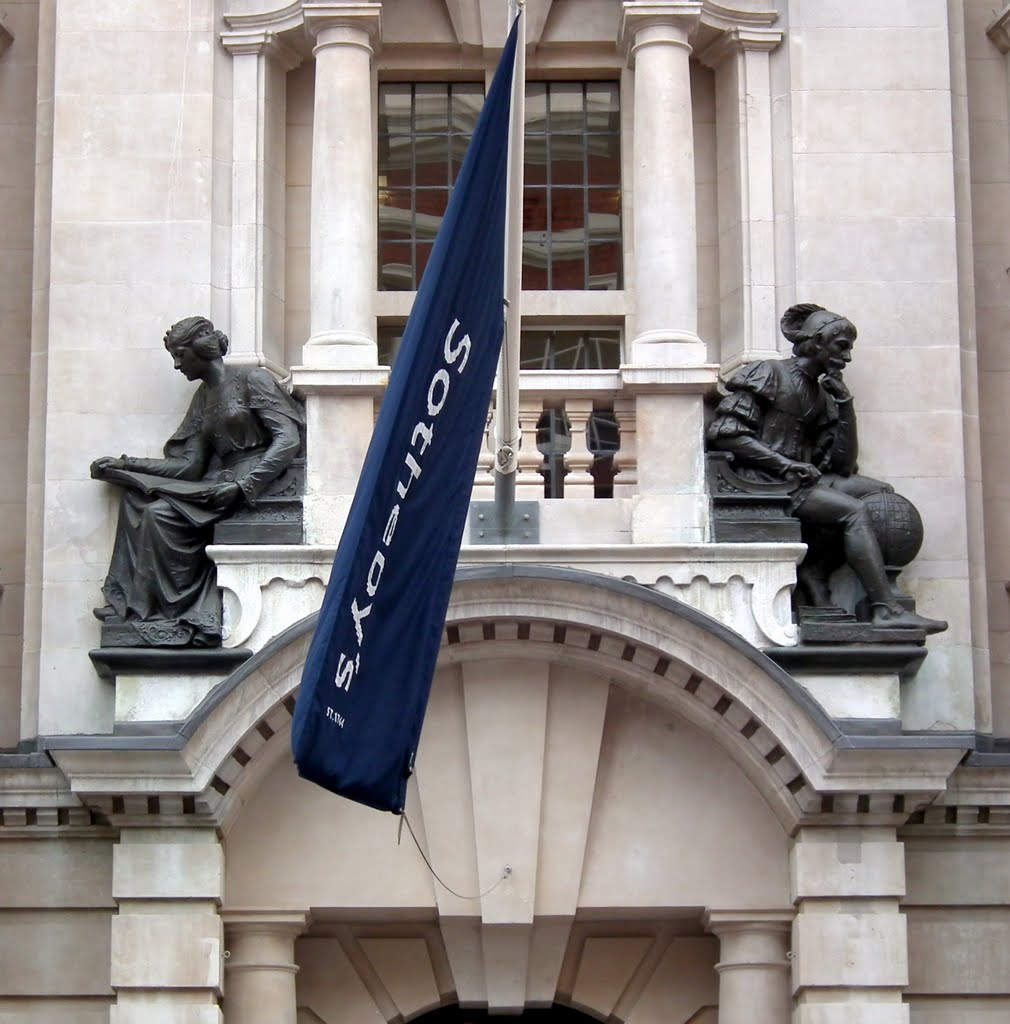

 Sotheby's St George Street gallery was originally built for some other purpose in 1904 by C.H. Worley. It has a pair of interesting and attractive bronze figures over the front entrance signed by Fritz Roselieb, the sculptor who changed his name to Louis Roslyn when he joined the Royal Flying Corps in WW1.
It was common for warriors with German names to change them, partly as a statement of patriotism but also for fear that if captured they would be taken for traitors and shot.
 This was particularly true of airmen who stood a good chance of crashing behind enemy lines.
Roslieb's figures seem to represent Ferdinand and Isabella considering the conquest of the world, though I could well be wrong, especially as Ferdinand is usually portrayed clean-shaven.
Isabella examines what looks like an atlas while Ferdinand stares moodily at a globe, one foot resting on a couple of books.
Why Ferdinand and Isabella? Does anyone know the original purpose or owner of the building?
Subscribe to:
Posts (Atom)