Saturday, 29 August 2015

Queen Mary University of London, Mile End Road E1

The prominent clock tower of 1890 in front of Queen Mary University of London was built in erected in 1890 in memory of Baron de Stern, a phenomenally rich financier who had been ennobled by the Portuguese government for services in lending them huge amounts of money.
It was part of a complex of halls, library and other public facilities called the People's Palace, designed by Edward Robson, the man who created the Queen Anne style of London's Board Schools.
The tower has a little treat for sculpture fans on the north face, hidden from the street behind a hedge.
The panel over the door is carved with a charming scene of a seabird flying over a shoreline, the sun on the horizon lighting the clouds from below. A sailing boat scuds over the water.
The words 'Time Trieth Troth' appear in the sky. This old proverb (listed by Heywood in 1546) means that faith or loyalty is tested by the passage of time, and was used often to describe the plight of the Jacobites in their weary and fruitless wait for the return of the Stuarts.
Why it appears on the clock tower is something of a mystery. 'Time Trieth Troth' was a popular heraldic motto but the Stern family seems to have favoured 'Vincit perseverantia' ('Perseverance Conquers', a drearily uplifting sentiment).


Friday, 31 July 2015

City Basin Lock, Regent's Canal N1

One of the great pleasures of cycling round London is coming across works of art like this, unobtrusively mounted on a wall on a canal towpath, quietly brightening my day.
Entitled A World in Islington, the four mosaics illustrate the changing canal landscape over the 200 years or so since it was built. They were created in 2010 by pupils at the Hanover Primary School just behind the wall. Artists Carina Wyatt and Cathy Ludlow 'helped', as they say.
My favourite panel shows narrowboats being hauled by horses to the basin where they are being unloaded.
"The Layered City" is particularly dramatic, showing how transport systems weave in, out and under each other in today's metropolis.  Love that scooter!
Today, the canal has lost its commercial function. I remember the canal rotting to death in the 1970s, so it is uplifting to see how it has become a focus for relaxation and fun. Love the dogs!
This panel is titled Tools and Trades, showing local industries including tailoring, hairdressing, musical instrument making, building and cooking. Difficult to photograph as it is half in the shade of a big tree. Love those 'taches!
Benches by the artists stand in front of the panels. They are much more 'finished' compositions and somehow lose the joie de vivre of the work the children were involved in. Still nice, though.

Wednesday, 29 July 2015

Moorfields Eye Hospital, City Road EC1


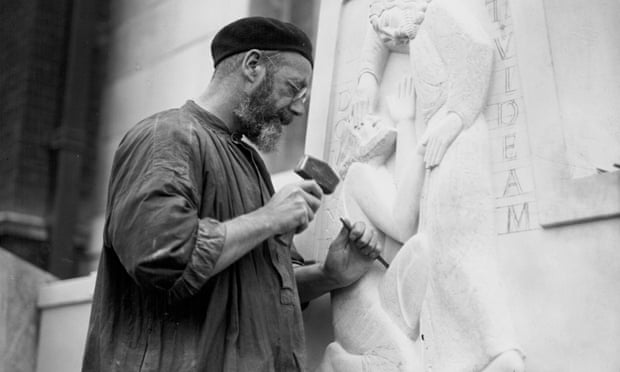
This small sculpture stands over the entrance to the 1933 extension to the famous Moorfields Eye Hospital.
It represents the story of the blind man Bartimaeus, who was begging by the side of the road from Jericho as Jesus passed by.
On hearing who was near, Bartimaeus began to make a fuss, calling for Jesus to have mercy. One of the perceptive little details that so often crop up in the Gospels is that the bystanders tried to get him to stop being such a nuisance, "but he cried the more a great deal, Thou son of David, have mercy on me."
In the sculpture, Jesus stands over Bartimaeus with his fingers touching his eyes. In the Gospel story, he asks "What wilt thou that I should do unto thee?", to which the blind man said "Domine, ut videam (Lord, that I might receive my sight)."
Christ then memorably says "Go thy way; thy faith hath made thee whole."
The sculptor, the deeply religious Eric Gill, gets the scene slightly wrong, I feel. It looks as though Jesus is applying a healing touch to the blind man, when actually he cured himself.

Thursday, 2 July 2015

Green Park SW1

I suspect that most of the tourists heading towards Buckingham Palace from Green Park station assume that the Diana fountain is a memorial to the notorious princess of the same name, but in fact she was created in 1954 by Estcourt "Jim" Clack.
Known as Diana of the Treetops, the goddess of the hunt and the forest is depicted spurring her greyhound off to a mark, the dog's leash swinging round in her hand. It is a figure full of energy, spinning as the dog springs away.
The statue was originally placed in the middle of the park where no-one ever passed, so in 2011 she was moved to her current location as part of the rebuilding of the tube station. At the same time she was restored and the flowers she stands on gilded to exotic effect.
The granite fountains beneath include a ground level drinking fountain for dogs, a considerate touch.
Jim Clack's only other work in London is the Dickens memorial plaque in Marylebone Road.

Tuesday, 30 June 2015

Riverside Walk Gardens, Millbank SW1

Locking Pieces is unmistakably by Henry Moore. Created in 1963, this version was presented by the sculptor to the Tate in 1978, who lent it to Westminster City Council to enliven a rather dreary triangle of riverside embankment created by the way the street has to veer inland to allow room for the roundabout at the end of Vauxhall Bridge.
Here's what Moore himself said to Alan Wilkinson in 1980:
"At one time I was playing with a couple of pebbles that I’d picked up, because behind my far field is a gravel pit and there are thousands of shapes and forms and one only has to go out there and I can find twenty new little ideas if I wish, immediately. Anyhow, I was playing with two pebbles which I found like that and somehow or other they got locked together and I couldn’t get them undone and I wondered how they got into position and it was like a clenched fist being tightly … Anyhow, eventually I did get it to [separate]; by turning and lifting, one piece came off the other. This gave one the idea of making two forms which would do that and later I called it ‘Locking Piece’ because they lock together."
I like the simple, unpretentious language, that of a child almost. So much more direct than the art-speak used by many graduates of university art departments.

Sunday, 28 June 2015

Park Lane W1

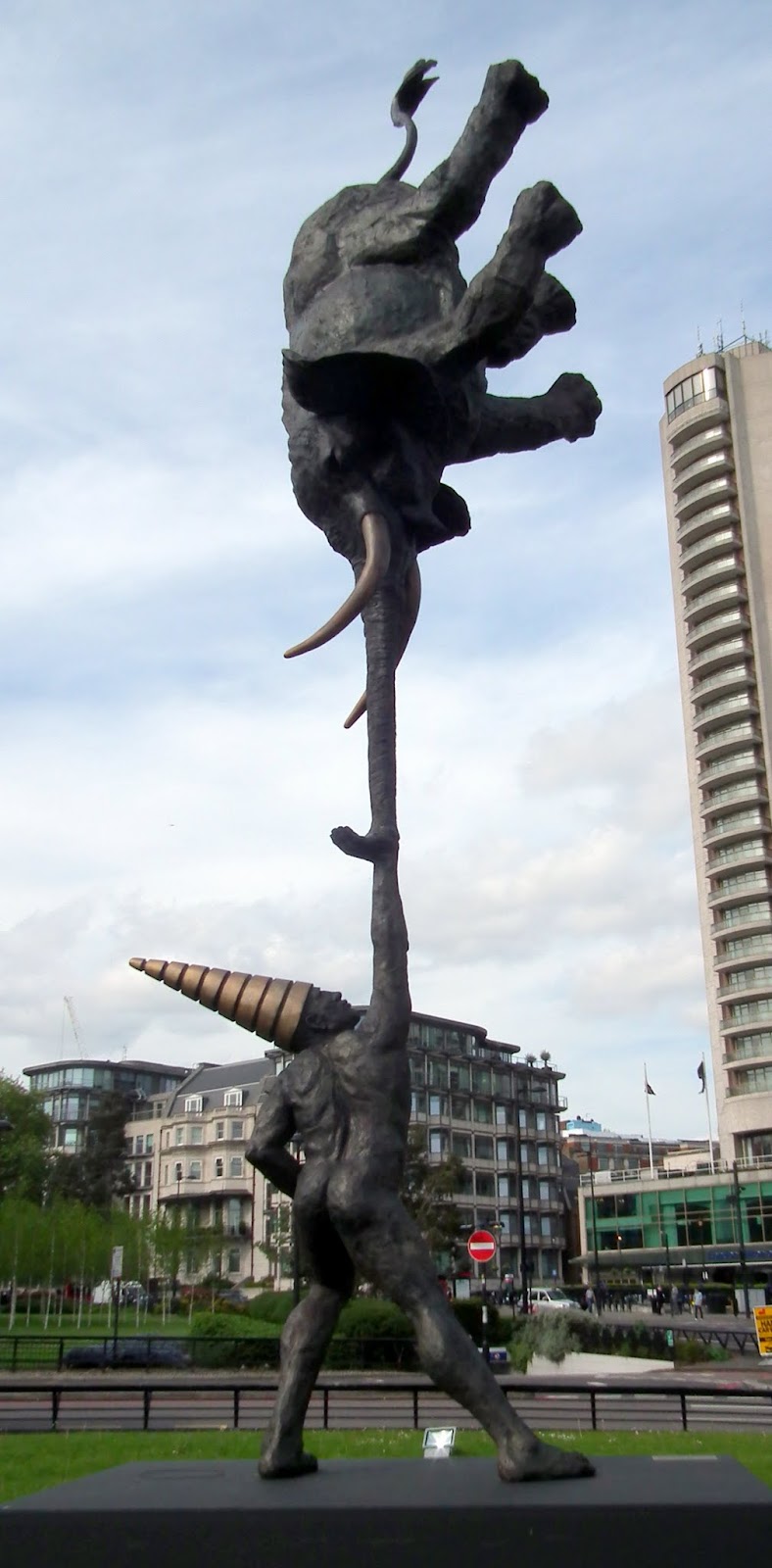
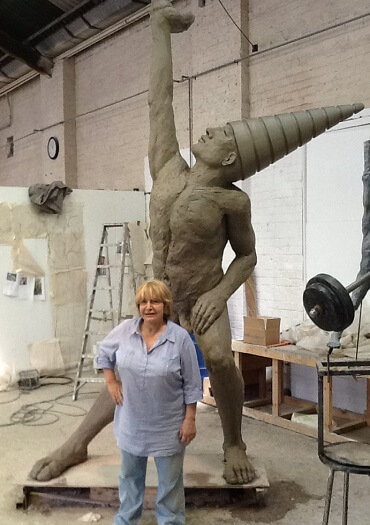
Dunamis was created in 2013 by the Lebanese-born, London-based sculptor Bushra Fakhoury.
According to the artist “It symbolizes human struggle to achieve excellence, pushing boundaries to make the impossible possible. We need to prioritise, work positively, and relentlessly towards reaching our goals, and dreams. Holding the elephant in a high position gives homage to the traits that we share and gradually forget, such as family ties, solidarity, compassion and cooperation. The ‘pointy hat’ represents the knowledge and power through the ages. We may not have the extraordinary memory of the elephant, but we need to remember to support the survival of the endangered species."
Dunamis in ancient Greek philosophy is the contrast between potentiality and actuality, as developed by Aristotle. Things have potentiality that is realised by change, thus achieving actuality. Or something like that. It is all a bit airy-fairy but was important in medieval theology, only being more or less abandoned when Newton's laws of motion put the whole thing in mathematical terms. Dunamis now survives in the word 'dynamic'.

Thursday, 18 June 2015

Tate Britain, Millbank SW1

The Rescue of Andromeda was the 'look at me - I've arrived' work of Henry Fehr, modelled in plaster in 1893 when he was an assistant to Thomas Brock and exhibited at the Royal Academy.
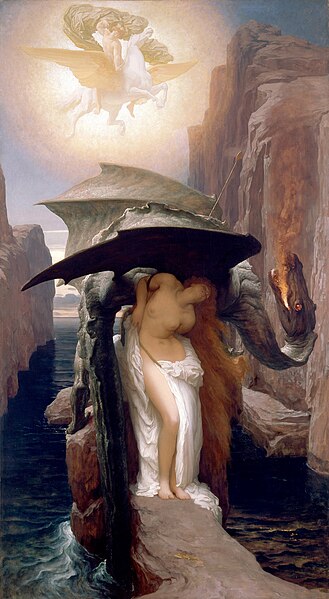
Lord Leighton, who had produced an acclaimed painting of the subject (left), encouraged Fehr to cast the work in bronze. That version was purchased for the nation under the Chantrey Bequest.
Andromeda was chained to the rock for the delectation of Cetus, a ravening sea monster sent by Poseidon to punish her mother Cassiopeia, who had unwisely claimed her daughter was more beautiful than Poseidon's attendents, the Nereids.
Happily, who should pass by but Perseus, wearing the borrowed helmet and sandals of Mercury and holding the head of Medusa. Mercury's helmet confers invisibility and Medusa's head turns anyone who looks at it into stone, but Perseus scorns these advantages and simply stabs the monster to death. They got married and lived happily ever after.
Fehr's take on the myth is unusual. Conventionally, she is shown standing with her wrists chained behind her so both the monster and us art lovers get a good view of what's on offer.
Fehr's Andromeda is lying on the rock with the monster on top - it's as close to rape as could be depicted in art in the late Victorian period. But because it is a classical subject it seems to have raised no eyebrows at all.
Another unusual aspect is the beauty of the head of Medusa - no serpent-haired harridan she.
The statue was originally placed inside the gallery but was moved to its position to the right of the main entrance in 1911, apparently to balance the similarly-sized Dirce to the left.
Fehr was outraged. He wrote to the Tate's director Charles Aitken: "It was never designed to be placed among and swamped by heavy masonry it is quite an injury to my work. Many times I have been complimented by judges of Art – and among them personally by Lord Leighton, Alfred Gilbert and Sir John Millais and others; at present many have said it is a shame to have placed a statue of this description in its present position."
He obviously didn't rate Sir Charles Lawes-Wittewronge's Dirce either, calling it in a later letter "a group of a heavy description which mine is distinctly not."