Monday, 29 April 2013

Royal Exchange, Royal Exchange Buildings EC3

The east wall of the Royal Exchange is adorned with figures of three major figures in London's mercantile history.
Above is Richard Whittington, so well known as a pantomime character many people don't realise he really was Lord Mayor of London in the 15th century. The younger son of a rich Gloucester merchant, he was sent to London to become a cloth trader or mercer and became vastly wealthy importing costly fabrics such as silk and velvet, and exporting English woollen broadcloth that was in high demand on the Continent. He survived in turbulent political times by the simple expedient of lending the current king lots of money.
The cat and the Bow Bells stuff is nonsense, and it seems he may never have been knighted either.
The 1844 statue, by John Carew, shows him in period costume with his chain of office and holding a formidable mace.
Carew was an Irish sculptor who had been an assistant to Sir Richard Westmacott, the father of the sculptor of the pediment group on the main facade of the Royal Exchange. He is well known for his church sculpture and one of the huge bronze reliefs on the base of Nelson's Column portraying the death of the admiral.
On the other side of the east facade of the Royal Exchange stands Sir Hugh Myddelton (right), the Jacobean draper who is now best known as the main promoter of the New River, a canal that brought fresh water into London from Hertfordshire. The Thames and all its local tributaries had become dangerously polluted, and boreholes were only affordable by industries such as brewing. The New River certainly saved more lives than the entire medical profession in the succeeding centuries.
The commission was given to Samuel Joseph, who delivered it in 1845. It shows Sir Hugh holding a scroll in one hand and a staff in the other, said to be the plan of the New River and a measuring rod. In 1999 the knight's right hand and the rod fell off, which must have been rather alarming for the pedestrians below, and have since been replaced.
Joseph was a brilliant young sculptor who won lots of prizes at the Academy Schools but somehow never made it to the top. He was made bankrupt only a few years after completing this statue, and died nearly penniless in 1850. The Royal Academy deserves credit for giving a pension to his widow to support their seven children.
The most important man on this facade is the Exchange's founder, Sir Thomas Gresham, and the architect has seen fit to put him so high you can only see him from practically underneath. The classic up-yer-doublet shot. When it was unveiled in 1845 the Art Union said it was "placed too high for any opinion of its quality to be formed."
The sculptor was William Behnes, a half-German, half-English, Irish-educated artist whose financial profligacy had reduced him to penury. He was declared bankrupt half way through the commission but he successfully completed it and was paid £550 (roughly £50,000 today). Behnes made a special trip to Suffolk to view a portrait of Gresham, then thought to be by Holbein, for the likeness.


Friday, 19 April 2013

Royal Exchange, Bank EC3

The Royal Exchange is right opposite the Bank of England and the Mansion House on the main intersection in the City, but people walk right on by. For such a florid and Victorian building, it seems to blend right into the background.
The original exchange was built by Sir Thomas Gresham in 1566 as a place for merchants to do business under cover - they had until then made deals walking down Lombard Street which can't have been entirely satisfactory.
Gresham's exchange had an open courtyard with a colonnade around like a cathedral cloister only in the classical style. It was destroyed in the Great Fire, rebuilt but again burned down in 1838.
The current building was designed by Sir William Tite, who brought in Richard Westmacott Jnr to do the sculpture of the pediment. Competitions were held for both contracts but the whole process was mired in incompetence and, it was said, corruption.
The central figure is Commerce, who holds the Charter of the Exchange in one hand and the rudder of a ship in the other. Next to her are a hive and a cornucopia, symbols of plenty. The inscription comes from Psalm 24, although Victorian merchants were just as prone as today's bankers to regard the earth and the fulness thereof as their own lawful booty and not the Lord's at all.
On Commerce's right hand stand the Lord Mayor, an Alderman and a Common Councilman, in their robes. It looks like the Tower behind.
Merchants from round the world stand further out and below the Brits, including a Hindu, a Muslim, a Greek holding an urn, an Armenian and a Turk. I suspect these nationalities were chosen for the picturesqueness of their clothes rather than any commercial importance.
The extreme corner, always a problem for pediments, is filled with maritime impedimenta.
To Commerce's left, two British merchants stand on a dock being shown some silk by a Persian. Beyond them a Chinese merchant stands with a Levantine sailor and a kneeling African. At the end, a British sailor binds a bale and a supercargo, the representative of the cargo's owner on board a ship and responsible for buying and selling. He is checking an inventory. The pointy bit is filled with assorted goods.

Monday, 1 April 2013

Animals in War Memorial, Brook Gate W1

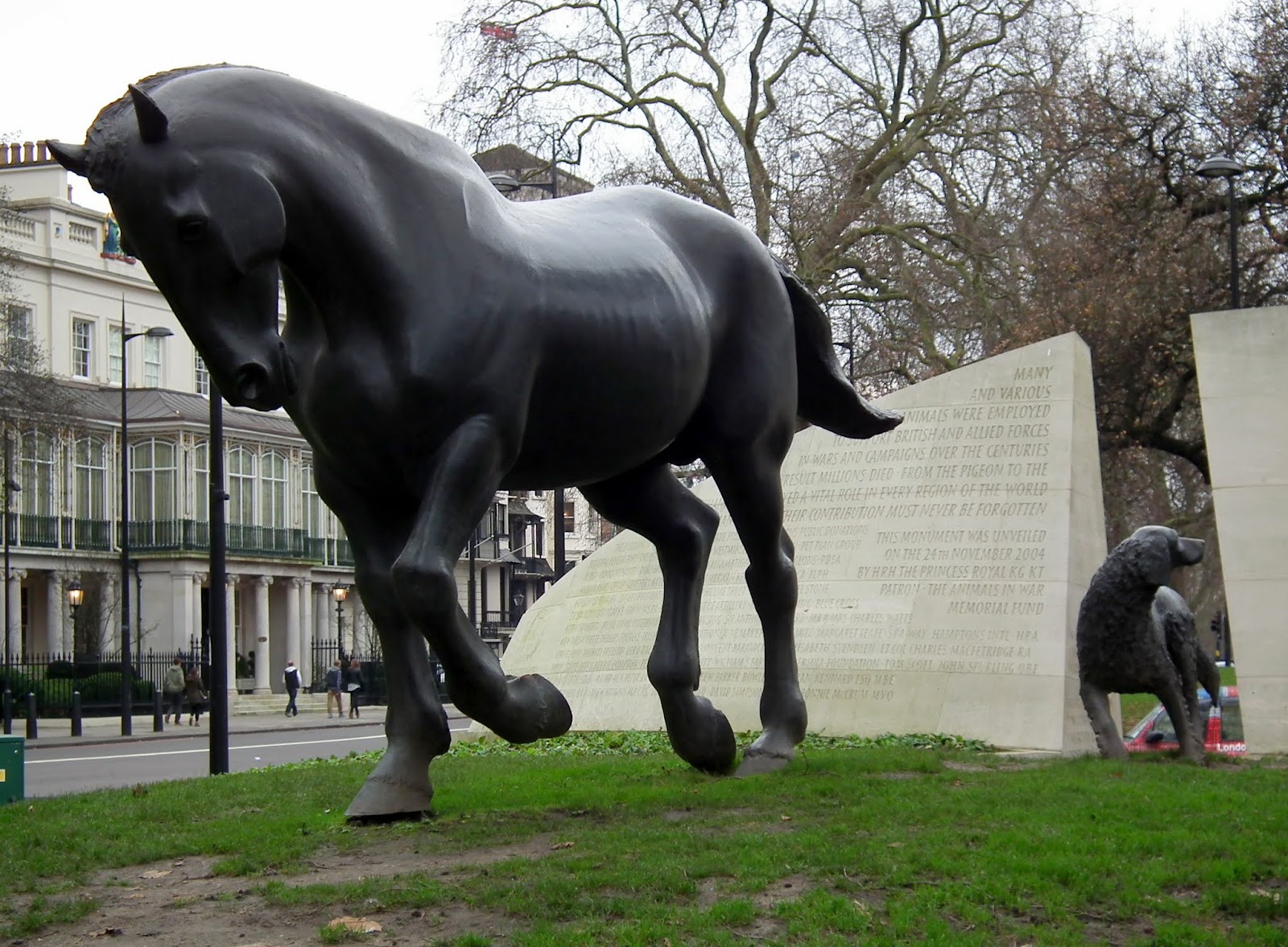
The Animals in War Memorial is a clever piece of work without a doubt. A high curved wall carved with images of animals used in war, from the mighty elephant to the smallest pigeon, defines a gateway through which a train of animals of war pass, shedding their heavy loads as they walk from the darkness of war to the grassy upland behind.
It is highly realistic, with every detail correct both anatomical and historical. It's important - the military history wonks will get you if a strap is out of position and the animal welfare types will create a fuss if a pastern is incorrect (as Dr Johnson discovered).
The memorial designed by David Backhouse and was unveiled in 2004 by the Princess Royal. It is impressive and touching, but not without a lavish dollop of sentimentality that I find a bit disturbing.
The big problem is that, like many modern war memorials, it is not specific enough. The best memorials are to named individuals or units with a story, such as Jagger's Royal Artillery memorial at Hyde Park Corner. The Animals in War memorial is dedicated to "all the animals that served and died alongside British and Allied forces in wars and campaigns throughout time." The result is a feeling not of sympathy for individual suffering but a general sigh of "aw, the poor animals."
The words at the side of the memorial give the game away: "They Had No Choice."
This hectoring, finger-wagging slogan says loudly and clearly: "It's not about the animals, it's about the bloody awful humans." 

Tuesday, 26 March 2013

Mornington Crescent NW1

Greater London House began life as a cigarette factory built in 1926 by ME & OH Collins for the Carreras company. It is not a thing of beauty, an enormous lump tricked out as a jazzy joke temple to the Egyptian cat-goddess Bubastis. The land of the Pharoahs was incredibly trendy because of the King Tut discovery a few years before. Following trends results in some spectacularly horrible buildings.
The cat motif was chosen because a black cat was the symbol of Carrera's best-selling Craven A cigs.
The original bronze cats on either side of the main entrance were removed when the factory was converted into offices in 1961, replaced with replicas in the restoration of 1998 that also brought back the flashy colour scheme.
But what makes the building really unacceptable is that it was built on the gardens of the Georgian terrace behind, which now look out on the service entrance of this monster. A sad fate for nice Georgian composition.


Friday, 22 March 2013

Gloucester Gate Bridge NW1

How accurate can a recreation of an old work of art be? This bronze plaque  in Regent's Park was made by the sculptor Stuart Smith from a photograph of an 1877 original by Ceccardo Egidio Fucigna.
The Gloucester Gate Bridge was built over an arm of the Regent's Canal and for some reason the Vestry of St Pancras decided to splurge some money on it. Perhaps William Thornton, named as the donor of the plaques, was making a bid for remembrance - he also left a rather charming cast iron fountain at St Pancras Old Church.
He chose Fucigna, an Italian from Carrara who had studied in Florence and Rome, to portray the Martyrdom of St Pancras, a Roman who was fed to the lions for his faith. Impressed by the young man's holiness, the beasts refused to attack until he gave them permission.
The bridge was highly ornate, in sandstone with standard lamps and stone figures. But it suffered brutally over time. The canal basin was filled in, so the bridge looks lost and meaningless. A wartime bomb destroyed all the figures. And a truck hit one of the bronze plaques, which went missing during the repair. The other was also stolen.
Recently, English Heritage decided to replace the panels but the only record of their appearance was a single photo. From this, Stuart Smith created a new plaque which was cast in bronze by Morris Singer.
It is impossible to tell how accurate the recreation is, but the figure of the saint seems rather epicene compared with the vigorous images on Fucigna's surviving work at Royal Holloway College. Pancras seems rather occupied in his own thoughts, ignoring both the lion that is gnawing his vitals and the rays of divine encouragement from above.

Thursday, 14 March 2013

One Hyde Park SW1

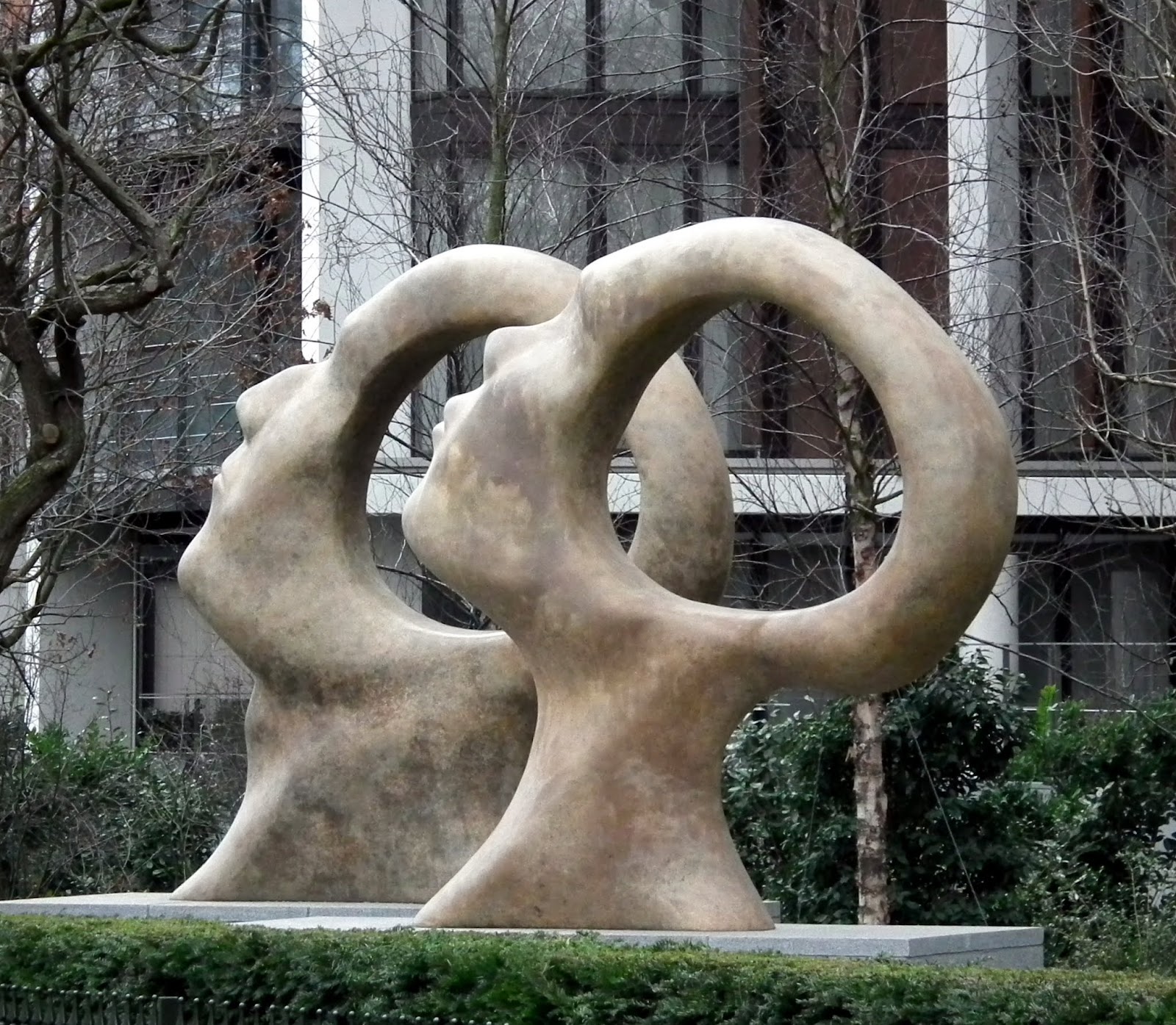
Sculpture can be difficult to photograph, especially if you can't get the angle you want. In the case of these figures I couldn't decide which angle is best.
From the side, showing the artful way the circles intersect? From the front, where they look a bit like Easter Island gods? I don't know, so here are all the pictures. You decide.
I also can't decide if they are true art or pretentious rubbish.
The fact that the figures are displayed outside the Candy Bros Occasional Home for the Stupendously Rich tends to indicate that they were bought off the shelf from the same dealers that supply Ramada hotels with all that stuff they put in their foyers. But that may be my prejudice.
The work is called Search for Enlightenment, and is by the British artist Simon Gudgeon. They are male and female, which you can easily see because the male has an Adam's apple the size of Suffolk. Their brains are empty, waiting to be filled with enlightenment.
The faces are expressionless but have genuinely individual features.
Expensive certainly. Good or bad?


Friday, 8 March 2013

Edinburgh Gate SW1

Behind Epstein's Pan-piping sunseekers an art work has been slipped in that is almost invisible most of the time. It is a pair of gates by Wendy Ramshaw, the noted jeweler and gates specialist.
The main gates swing on posts in the middle of the road, closing against smaller gates across the pavements.
When the gates are open, everyone shoots past without pausing to look. When they are closed, they are hidden down a blind alley. They must be the only art works designed to be overlooked.
Did Wendy Ramshaw subconsciously realise this when she was designing them? They are not her most characteristic work. Usually, she arranges gates to form new patterns when they overlap, but here she seems not to have done so. Which is a pity as they spend most of their time folded together.