Burlington House is a bit of a pudding, really, as you might expect from a government project. The Georgian palace of the amateur architect Lord Burlington was bought in 1854 to house various academic institutions that were cluttering up Somerset House and Marlborough House, which were needed for bureaucrats.
There was a scheme for intensive redevelopment including shops but public protests put a stop to that. Instead Sidney Smirke was employed in 1872 to convert it for the Royal Academy, adding another storey to the original facade by Colen Campbell. Its most prominent feature is a row of niches containing statues of artistic heroes by some of the best Victorian sculptors.
From left to right, they are
Phidias, by Joseph Durham ARA. The greatest sculptor of classical times, creator of the statue of Zeus at Olympia and the chryselephantine image of Athena in the Parthenon, is depicted bald as Greek writers always maintained, holding a panel carved with a hero taming a stallion.
Leonardo da Vinci, by Edward Stephens ARA. The famously bearded artist holds a brush and palette.
John Flaxman RA by Henry Weekes RA. Flaxman's funerary monuments abound in churches from St Pauls (Nelson) to humble parish churches everywhere. His most notable achievement, however, was to direct British sculpture towards the Classical Greek model under the influence of the Elgin marbles.
Raphael, by Henry Weekes. Another brush'n'palette pose.
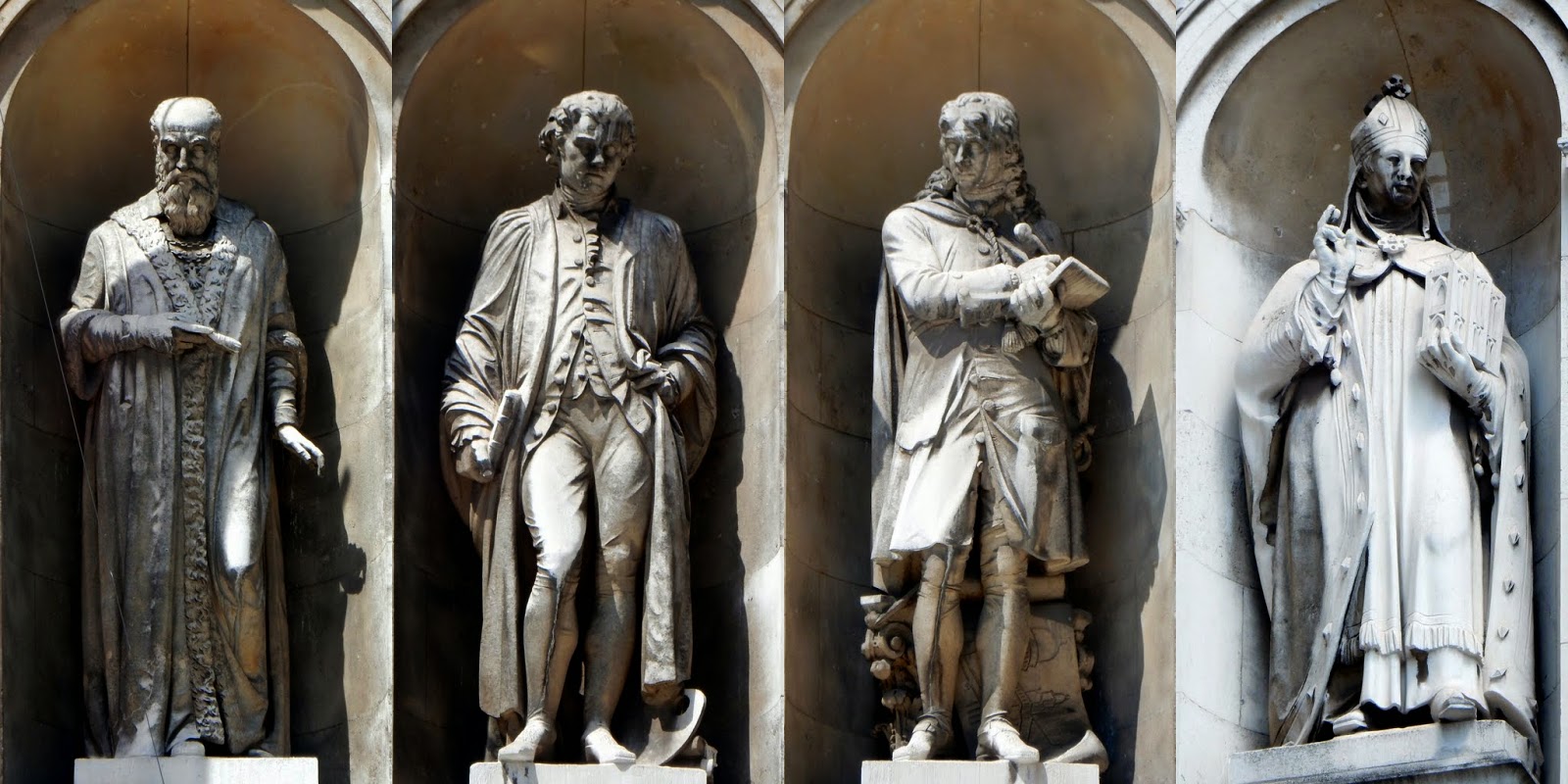
In the middle is Michelangelo, by William Calder Marshal, currently hidden behind an ad for the Summer Show. Continuing left to right:
Titian by William Calder Marshall RA, a Scottish sculptor also famous for gooily sentimental works such as First Whisper of Love.
Sir Joshua Reynolds and Sir Christopher Wren, both by Edward Stephens.
William of Wykeham, not an artist but a bishop who administered building works for 14th century monarchs. By Joseph Durham.
The forecourt is all about Reynolds, appropriately as its founder, first president and despot for more than twenty years. The 1929 statue is by Alfred Drury, who had a strong line in historical portrait sculpture including Richard Hooker (Exeter) and Elizabeth Fry in the Old Bailey. Pevsner calls it 'bijou' but I think it captures the slight figure but energetic and intellectual nature of the man.
Even the trendy waterspouts in the paving installed in 1999 are arranged according to Reynolds' horoscope.
Wednesday, 30 July 2014
Friday, 25 July 2014
21 John Street WC1
It would be easy to dismiss 21 John Street as just another example of developer greed, sticking rudely above the elegant Georgian roofscape, but the standard of the architecture just about redeems it. The designer was Dennis Harrington, it was completed in 1938 and the style is pure Moderne.

The statues on attached pylons on either side of the main entrance are other redeeming features. Nude women hold an hour glass (left) and a magic square and astrolabe (right).
The items would indicate the offices were intended for a company with interests in navigation or instrumentation, but the block was built on spec so it would seem they were either chosen on a whim or simply because they were a standard design available from one of the big firms of architectural sculptors (I have so far been unable to establish who supplied them).
There was a lot of interest in magic squares at the time. This one is the pattern made famous by Durer - practically any combination of four numbers adds up to 34. There is another one on the NatWest Bank in the City.
The items would indicate the offices were intended for a company with interests in navigation or instrumentation, but the block was built on spec so it would seem they were either chosen on a whim or simply because they were a standard design available from one of the big firms of architectural sculptors (I have so far been unable to establish who supplied them).
There was a lot of interest in magic squares at the time. This one is the pattern made famous by Durer - practically any combination of four numbers adds up to 34. There is another one on the NatWest Bank in the City.
Labels:
Dennis Harrington,
magic square
Location:
21 John Street, London WC1N 2BF, UK
Monday, 14 July 2014
Ludgate House, Fleet Street EC4
Ludgate House, the north-west quadrant of Ludgate Circus, was built in 1872 as the headquarters of Thomas Cook the travel agents.
But this charming huddle of winged merboys on the top was not in the original design - it seems to have been added when the building was extended up Fleet Street in 1906.
The rest of the extension matches the original design (by Horace Gundry), even to the ornately carved lintels on the windows with their exotic faces intended to convey the incredibly rich variety of the human race that might be observed on a foreign tour. Actually, all the faces look very similar, a classically beautiful, very Grecian face, with an incredibly rich variety of exotic headdress.
Only the rather jolly Chinaman stands out as a real personality.
At the attic level, an entertaining group of touristic cherubs represent travel round the world. At top right, cherubic travel agents make an inventory. Navigators plot courses both celestially and terrestrially. Sailors bring in a cruise dinghy, and fat little weather cherubs ride the Sun's chariot, one brandishing a thunderbolt.
Even the doorways are guarded by chubby little chappies representing travel over the globe.
The rest of the extension matches the original design (by Horace Gundry), even to the ornately carved lintels on the windows with their exotic faces intended to convey the incredibly rich variety of the human race that might be observed on a foreign tour. Actually, all the faces look very similar, a classically beautiful, very Grecian face, with an incredibly rich variety of exotic headdress.
Only the rather jolly Chinaman stands out as a real personality.
At the attic level, an entertaining group of touristic cherubs represent travel round the world. At top right, cherubic travel agents make an inventory. Navigators plot courses both celestially and terrestrially. Sailors bring in a cruise dinghy, and fat little weather cherubs ride the Sun's chariot, one brandishing a thunderbolt.
Thursday, 10 July 2014
Sidney Estate, Somers Town N1
The assembly room was never built and today the estate looks rather like hundreds of others except for the ceramic lunettes of fairy tales, designed by Gilbert Bayes and made by Doulton.
| The Sleeping Beauty with Prince, flanked by what appear to be a leopard and a mastiff. |
The estate was originally called the Sidney Street Estate after the road that disappeared when it was built. Just as well really as if it had survived it would only be confused with Sidney Street, Shoreditch, location of the famous siege.
| The arch between St Anthony's Flats and St Francis' House has a statue that I originally assumed was St Francis but is actually St Anthony of Padua. |
| My personal favourite |
Labels:
gilbert bayes
Thursday, 26 June 2014
Fen Court EC3
This remarkable piece of 2007, Gilt of Cain, is a collaboration between the sculptor Michael Visocchi and the poet Lemn Sissay to mark the 200th anniversary of the abolition of the Atlantic slave trade.
The granite columns are shaped to resemble sugar cane, the product most slaves were taken from Africa to the Caribbean to grow and process into sugar. Before them is a podium with a short flight of steps.
This arrangement has a dual purpose. In one sense, they can be viewed as a pulpit and a congregation of abolitionists, recalling the role of the church in the abolitionist cause. A deliberate reference is to the Rev. John Newton, author of Amazing Grace and inspirer of William Wilberforce, who was rector of nearby St Mary Woolnoth.
In contrast, the group can be seen as a crowd of slaves in front of the auctioneer's desk.
This arrangement has a dual purpose. In one sense, they can be viewed as a pulpit and a congregation of abolitionists, recalling the role of the church in the abolitionist cause. A deliberate reference is to the Rev. John Newton, author of Amazing Grace and inspirer of William Wilberforce, who was rector of nearby St Mary Woolnoth.
In contrast, the group can be seen as a crowd of slaves in front of the auctioneer's desk.
Labels:
Lemn Sissay,
Michael Visocchi
Location:
Fen Court, London EC3M, UK
Friday, 13 June 2014
Broadgate Circle EC2
American artist Richard Serra's enormous 1987 piece, Fulcrum, consists of five enormous, 55ft steel slabs apparently leaning against each other, though they are in fact welded together at the top to stop them falling over and incommoding passers-by. The idea is that art lovers can go inside, look up and watch the clouds scud overhead.
Unfortunately, Broadgate's health'n'safety crew seems to have doubts about the integrity of the welds, because they have installed their own counter-art installation Crowd Control Barriers to keep everyone out. Or perhaps the giant wigwam was being used as a refuge by smokers who, let's face it, have nowhere else to go these days.
Serra has made enormous sheets of steel his life's work. Google 'Richard Serra enormous pieces of steel' and select the 'images' option if you want to see what I mean.
Unfortunately, Broadgate's health'n'safety crew seems to have doubts about the integrity of the welds, because they have installed their own counter-art installation Crowd Control Barriers to keep everyone out. Or perhaps the giant wigwam was being used as a refuge by smokers who, let's face it, have nowhere else to go these days.
Serra has made enormous sheets of steel his life's work. Google 'Richard Serra enormous pieces of steel' and select the 'images' option if you want to see what I mean.
Labels:
richard serra
Location:
Broadgate Circle, London EC2M, UK
Thursday, 12 June 2014
199 Bishopsgate EC2
This cheeky girl sketched out in painted steel lines stands high outside Broadgate, commissioned by the developers from artist Bruce McLean in 1993. He calls it Eye-I, which sounds a bit like the comment of a policeman inquiring what a girl like her is doing hanging round on the street at that time of night.
Bruce McLean was born in Glasgow, studied in the School of Art there and then at St Martin's, where he was taught by Antony Caro. He reacted against his teacher by making sculpture from rubbish.
Labels:
Bruce McLean
Location:
199 Bishopsgate, London EC2N 3AB, UK
Subscribe to:
Posts (Atom)


