American artist Richard Serra's enormous 1987 piece, Fulcrum, consists of five enormous, 55ft steel slabs apparently leaning against each other, though they are in fact welded together at the top to stop them falling over and incommoding passers-by. The idea is that art lovers can go inside, look up and watch the clouds scud overhead.
Unfortunately, Broadgate's health'n'safety crew seems to have doubts about the integrity of the welds, because they have installed their own counter-art installation Crowd Control Barriers to keep everyone out. Or perhaps the giant wigwam was being used as a refuge by smokers who, let's face it, have nowhere else to go these days.
Serra has made enormous sheets of steel his life's work. Google 'Richard Serra enormous pieces of steel' and select the 'images' option if you want to see what I mean.
Friday, 13 June 2014
Thursday, 12 June 2014
199 Bishopsgate EC2
This cheeky girl sketched out in painted steel lines stands high outside Broadgate, commissioned by the developers from artist Bruce McLean in 1993. He calls it Eye-I, which sounds a bit like the comment of a policeman inquiring what a girl like her is doing hanging round on the street at that time of night.
Bruce McLean was born in Glasgow, studied in the School of Art there and then at St Martin's, where he was taught by Antony Caro. He reacted against his teacher by making sculpture from rubbish.
Labels:
Bruce McLean
Location:
199 Bishopsgate, London EC2N 3AB, UK
Wednesday, 11 June 2014
County Hall Apartments, York Road SE1
The pair of blocks were designed by the LCC Architect's Department with advice from Sir Giles Gilbert Scott as offices for the council's thousands of officers controlling everything from town planning to vehicle registration. The initial phase was completed in 1939.
The entrances are guarded by stone lamp standards with delightful capitals carved by Alfred Oakley. One type features a school of leaping fish, the other a pod of leaping dolphins.
Tuesday, 10 June 2014
Hanover Gate Lodge, Regent's Park NW8
Regent's Park was originally private, a place for the rich and aristocratic residents to enjoy without being troubled by the unsightly, smelly and disorderly proletariat.
The lodge was designed in about 1822 by Sir John Nash, and was originally flanked by iron gates. Elegant statues stand in niches on the Park side, presumably made of Coade stone. They seem to represent the seasons, possibly spring and autumn, though bits may have dropped off over the years.
The Park was opened to the public in 1835, initially for just two days a week. Eventually, however, the beadles left, the gates were removed and the lodge became a bijou residence, albeit one in the middle of its own bijou traffic island.
Monday, 9 June 2014
St Mary Axe, EC3
The workers at 30 St Mary Axe, universally known as the Gherkin, file past this curious figure as they head for the lifts every morning. It is called Grosse Geister, it was made in 1996 and is the work of the Dusseldorf-based artist Thomas Schutte.
The material is cast aluminium, highly polished. Schutte made 17 different versions of Grosse Geister, each in a trio in aluminium, bronze and steel. Schutte creates the shapes in miniature using extruded plastic modelling material.
The work's title translates rather badly into English, apparently. Literally, it means Great Ghosts or Big Spirits, but the connotations of spirituality, greatness of mind, otherworldliness and so on are lost.
Its towering presence (it is 8ft 6in tall) and strange swirly shape have inspired critics to very inventive descriptions including "part Darth Vader, part Pillsbury Doughboy", "licorice humanoids" and, from the Gherkin's own website, "a cross between Ghostbusters, the Michelin Man, Michael Jackson moonwalking, Terminator 2 and a burger bar customer."
The material is cast aluminium, highly polished. Schutte made 17 different versions of Grosse Geister, each in a trio in aluminium, bronze and steel. Schutte creates the shapes in miniature using extruded plastic modelling material.
The work's title translates rather badly into English, apparently. Literally, it means Great Ghosts or Big Spirits, but the connotations of spirituality, greatness of mind, otherworldliness and so on are lost.
Its towering presence (it is 8ft 6in tall) and strange swirly shape have inspired critics to very inventive descriptions including "part Darth Vader, part Pillsbury Doughboy", "licorice humanoids" and, from the Gherkin's own website, "a cross between Ghostbusters, the Michelin Man, Michael Jackson moonwalking, Terminator 2 and a burger bar customer."
I hope the money men who pass it every day treat the great spirit with more respect. In 2010, Phillips sold one for $4.1m.
Labels:
Grosse Geister,
thomas schutte
Tuesday, 3 June 2014
Broadgate Circle EC2
Some time in the 1970s, the sculptor Barry Flanagan was inspired by the 'magical' sight of a hare sprinting across the South Downs. Through the rest of his career he turned again and again to this graceful, lithe but strong and resilient creature.
Hares were sacred to the Ancient Britons - the Earth Mother Eostre changed into a white hare at the full moon, a belief that has decayed sadly into the Easter Bunny of today.
Flanagan's piece for Broadgate Circle is called Leaping Hare on Crescent and Bell and was placed here in 1988.
Hares were sacred to the Ancient Britons - the Earth Mother Eostre changed into a white hare at the full moon, a belief that has decayed sadly into the Easter Bunny of today.
Flanagan's piece for Broadgate Circle is called Leaping Hare on Crescent and Bell and was placed here in 1988.
Labels:
barry flanagan
Location:
Broadgate Circle, London EC2M, UK
Saturday, 24 May 2014
Great Cumberland Place W1
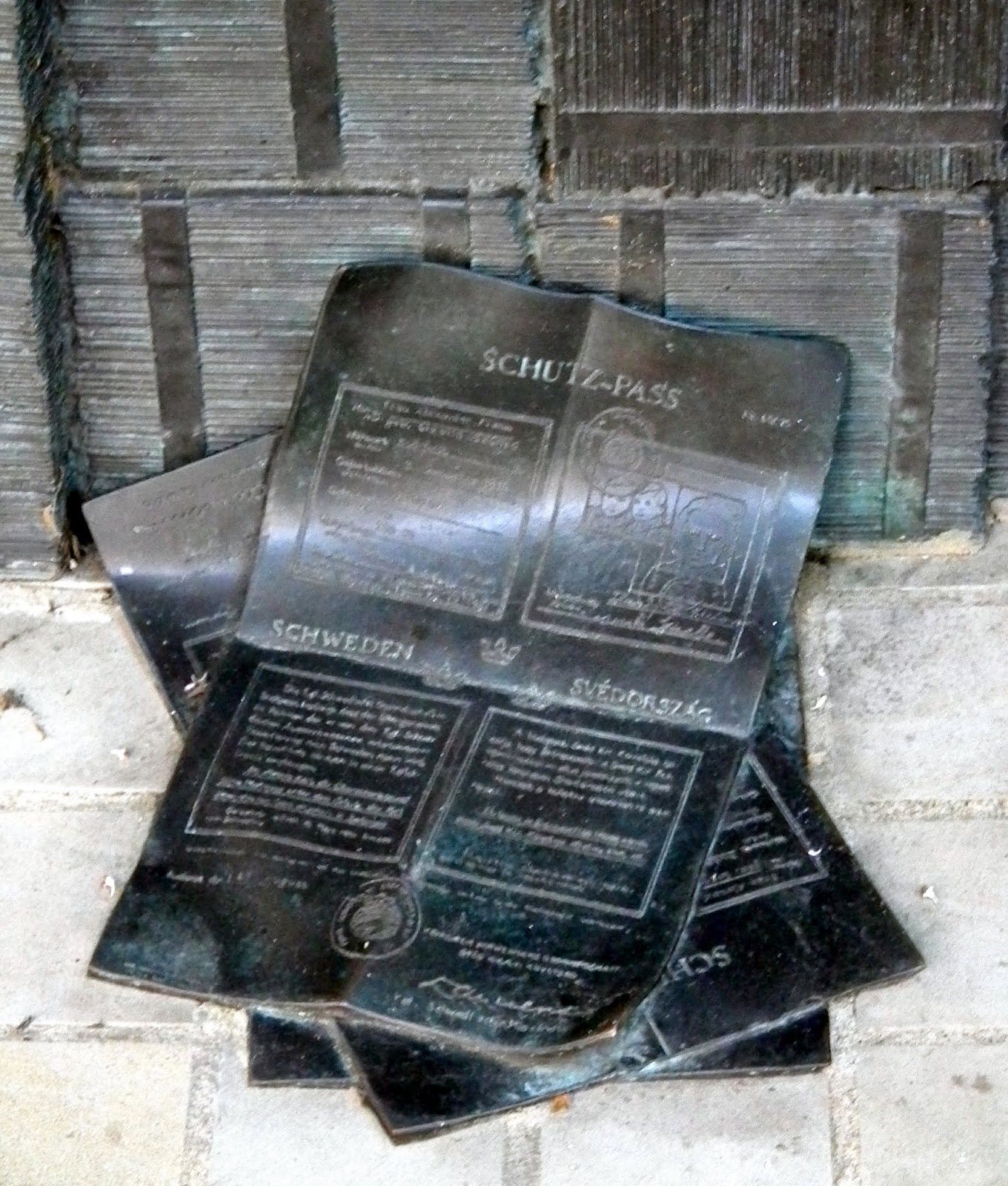
In the siege of Budapest in 1944 Raul Wallenberg saved possibly as many as 100,000 Jews from the gas chambers by issuing them with emergency Swedish passports.
During the last days of the siege, Wallenberg was taken by the Soviets and was never seen again.
The noble monument by Philip Jackson is a full-length portrait of Wallenberg standing against a concrete wall that is revealed on going behind to be a pile of the passports with a flag draped over. A few lie loose in front, engraved with the words.
Wallenberg is nattily dressed, the epitome of a wealthy businessman. He grasps a bundle of passports in his right hand and holds his coat over them with his left, an apparently confident gesture but his knuckles are tightly clenched.
Labels:
philip jackson,
wallenberg
Location:
Great Cumberland Place, London W1H, UK
Subscribe to:
Posts (Atom)