Tuesday, 25 June 2013

Heritage Court, Sampson Street E1

This vivacious Pegasus enlivens a very dull building that may have been built as a telephone exchange, probably in the 1950s by the look of it. The whole area was more or less flattened in the War, so it is unlikely to date back to the 1930s.

Saturday, 22 June 2013

Lalit Hotel, Tooley Street SE1

This neo-Baroque pile was built as St Olave's Grammar School by the architect E. W. Mountford in 1894. The school moved to Orpington in the 1960s and the building was used by various educational institutions before finally being sold off as a boutique hotel.
The facade has three big segmental pediments featuring allegorical reliefs. There seems to be no direct record of the sculptor responsible, but Public Sculpture of South London attributes them to Paul Montford, on the basis that he carved a chimneypiece in the Governors' Room. Montford was one of Mountford's regulars, having been employed on that architect's Town Hall and Polytechnic buildings in Battersea as well as his Northampton Institute (now City University).
The central pediment shows two schoolboys reclining, one studying and the other holding a cricket bat. The dates refer to the date of letters patent for the school, which had been funded by a bequest of £8 a year in the will of a Southwark brewer called Henry Leeke, and the rebuilding.
The pediment on the left celebrates the arts, with a bust of Homer in the middle supported by the masks of comedy and tragedy. Poetry plucks her lyre and History records an event. Various bits of classical junk lie at their feet including a helmet and a winged globe.
Science features in the pediment on the left. A bust of Newton is flanked by Science, an Egyptian holding a dagger and a snake (I hope he isn't considering a dissection), and Philosophy, holding Newton's apple.
Various symbols of wisdom are scattered around, including an owl, a snake eating its own tail and a classical lamp.


Friday, 14 June 2013

Evelyn Court, Stourcliffe Street W1

The mansion blocks that line Edgware Road are seedy now, bearing the scars of decades of low-cost maintenance and lazy workers installing cables for phones, security systems and lights.
But they were high status back in the 1930s when they were built, as shown by the trouble the developers took over the entrance to the flats above Evelyn Court.
The doorway is surrounded with a delicate beaded string and given emphasis with a carved lintel. It is very Moderne, with no frivolous ornament - ironically, as the piece is itself an ornament.
The Marble Arch at the centre is stripped of all its classical flimflam, the bus climbing up the hill in the background is streamlined and sleek, and the houses have randomly-placed windows implying a 'formfollowsfunction' ideology. The sky is paved.
Trees are the only living things in this landscape.

Wednesday, 29 May 2013

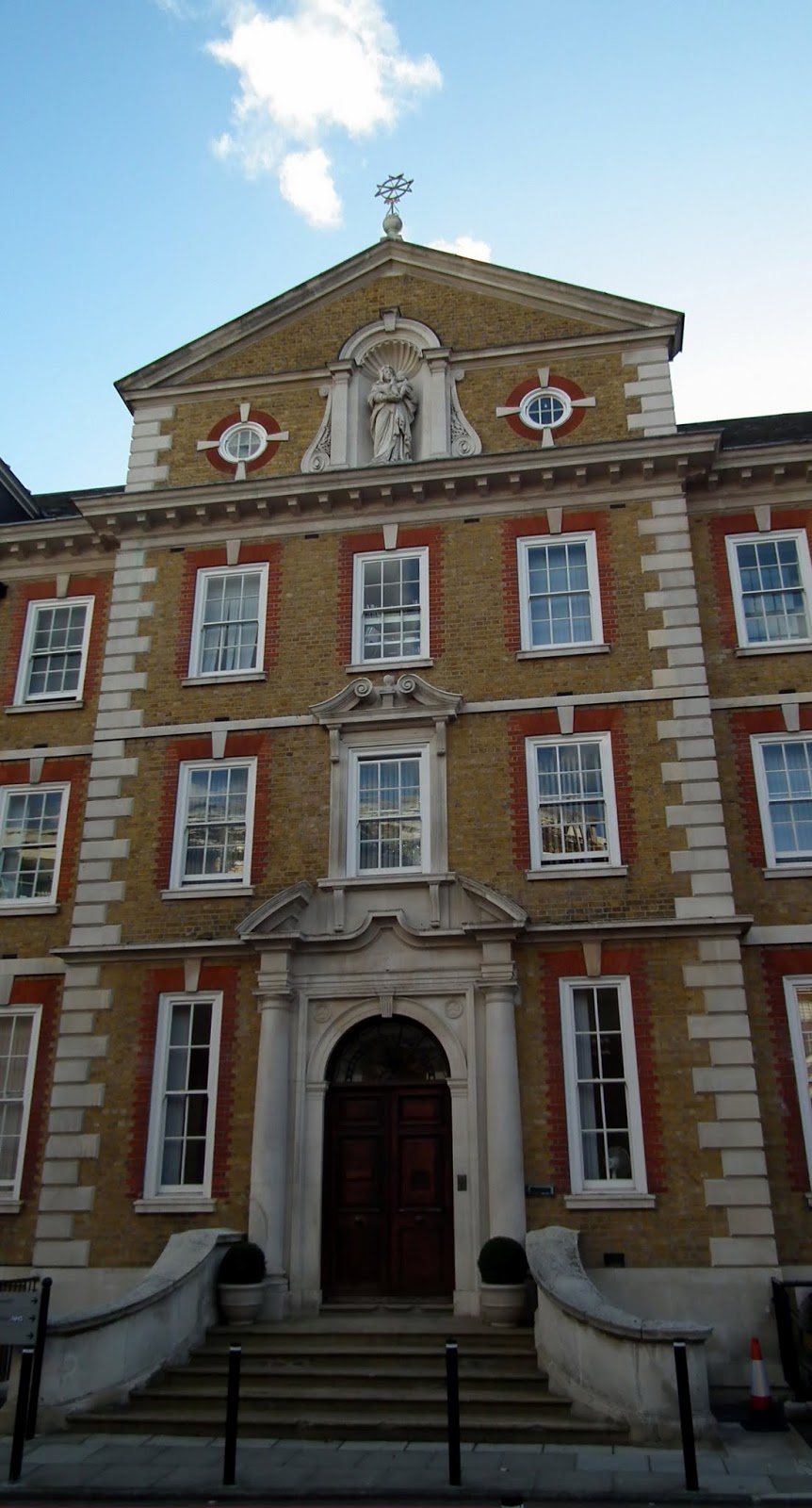
Hospital of St John and St Elizabeth, Circus Road NW8


One would expect the figures over the entrance of the Hospital of St John and St Elizabeth to be, well, John (the Baptist) and his mother Elizabeth.
But Elizabeth was so old she had despaired of ever having a child, and this mother is young. Her baby raises his right hand up in blessing and in his left holds an orb, a symbol of kingly power usually reserved for Jesus.
So they must be the Madonna and Child.
This wing of the hospital was designed by Edward Goldie in 1902 as an extension to the main 1898 building, also designed by Goldie. The chapel front has a Maltese cross, a symbol of the Knights Hospitaller whose successor order runs the hospital today, and also of St John the Baptist.

Tuesday, 28 May 2013

1 Moorgate EC2

This splendid pair of doors is on 1 to 5 Moorgate, a typically City office of 1906 by Mountford and Gruning, but the whole shebang was redeveloped behind the listed facade in the 1980s.
The bronze castings are swirly dramatic images of women, the one on the left almost nude, the one on the right modestly dressed. Spring and Autumn perhaps?
I have been unable to find who created these lovely things. All suggestions gratefully received.

Wednesday, 22 May 2013

Old Southwark Town Hall, Walworth Road SE1


After 1820 building proceeded apace, but as late as 1853, when Harriet Beecher Stowe stayed with the Rev. Thomas Binney at Rose Cottage on the site of the present Town Hall, she found it a "charming retreat" with a view from the windows of sheep and lambs grazing in a meadow.
Built in 1864–66 from the design of Henry Jarvis.
I used to think these were portrait heads, but now I think it is more likely they are personifications of winter and summer.

Saturday, 18 May 2013

St George's Gardens WC1

I always assumed that St George's Gardens was the graveyard of a long-demolished church, but the other day I actually read the info board at the entrance and it is much more interesting.
The site one of the first cemeteries to be located not round a church but in remote fields. London churches could no longer afford the luxury of extensive churchyards, and the dangers to health of crowded graves in the crowded city had become apparent.
The land was bought in 1713 to serve two churches, St George Queen Square and St George Bloomsbury, the latter yet to be built. 
It was some time before the idea of being buried away from the protection of the church took off, and matters cannot have been helped by the cemetery being the site of the very first case of bodysnatching for anatomists, in 1777.
Eventually, the cemetery filled and in 1855 it was closed. Thirty years later it was turned into the gardens we see today.
This terracotta statue is much later and interesting in itself. Dating from 1898, it was part of a set representing the nine muses modelled by John Broad and made by Doultons in Lambeth. They used to stand on the Apollo Inn in Tottenham Court Road, designed by the Russell Estate's favourite architect C. Fitzroy Doll. The pub was demolished in 1961 for an extension to Heals, the department store. Ambrose Heal presented this one, Euterpe, the Muse of Instrumental Music, to the borough who placed it in the gardens.
Sir Nikolaus Pevsner, the architectural historian, got rather peeved about the demolition as he had only just gone to the trouble of researching the Apollo for his famous guide. He more or less forced Heal to sell him the statue of Clio, Muse of History, for the knock-down price of a fiver and put it up in his garden in Hampstead.
Euterpe seems to have been a bit of a favourite subject for Broad - he modelled her again for the noted theatre architect Frank Matcham, who placed Doulton copies on the Richmond Theatre and the Hackney Empire.