Saturday, 30 July 2016

London School of Economics Old Building, Clare Market WC2

The Clare Market facade of the LSE's old library was added in 1932 by the architect A.S.G. Butler, best known these days as the author of many books on Lutyen's works. It is decorated by sculpted panels by Edgar Silver Frith, a member of a sculptural dynasty and lecturer at the South London Technical School of Art.
Apparently they represent different modes of thinking, from which we can conclude;
a) Thought hurts;
b) Thought is done exclusively by men.

The Thinking Men are currently obscured by construction so these pictures are provisional.

30 Russell Square WC1

Joseph Priestley sits over the main entrance of Birkbeck College, his head resting in his left hand, examining a huge scroll that drops over this lap down to the floor. Is he boning up on the latest developments in chemistry? or electricity? or theology? or English grammar? Perhaps he is studying one of languages he spoke, including Greek, Latin, Hebrew, French, Italian, German, Arabic and Aramaic? He was a true Renaissance man.
The statue was carved by Gilbert Bayes in 1914 when the building was erected for the Royal Institute of Chemistry, to designs by Sir John Burnet. Priestley is today remembered most for his part in the discovery of oxygen, though he called it 'dephlogisticated air.' reflecting his unyielding attachment to the phlogiston theory that was being debunked at the time by his arch-rival Lavoisier.


Tuesday, 17 May 2016

Cook Memorial, The Mall SW1

Captain Cook is one of my all-time heroes, possibly the greatest navigator who ever lived.
This 1910 statue is by Sir Thomas Brock. It retains a naval setting, standing in front of the Admiralty extension of the 1890s with its wireless telegraphy aerials preserved from the days of the Dreadnoughts. Cook would have known their predessor, the giant semaphore tower that clicked and clacked its messages for transmission down a chain to the fleet at Portsmouth.

Friday, 6 May 2016

Royal Marines Memorial, The Mall, SW1

This noble figure of a Marine standing guard over a fallen comrade was created by Adrian Jones in 1903 to commemorate the fallen of the South African wars and the Boxer Rebellion in China.
The sculptor was self-taught, taking up sculpture after serving as an Army vetinerary officer, facts which help explain the unconventional but moving composition and the correct military detail.
The plinth was designed by the architect Sir Thomas G Jackson, and incorporates two bronze reliefs by Jones depicting on the left the Battle of Graspan in the Boer War and on the right the defence of the International Legations in the Boxer Rebellion.
Though a victory, the Battle of Graspan was not exactly a glittering example of British military prowess. General Lord Methuen completely failed to understand the threat posed by long range rifle fire, enabling the undisciplined but hotshot Afrikaaner farmers to create havoc from their hilltop positions.
The main British advantage was in artillery, famously including two long naval 12 pounders taken from HMS Doris and mounted on improvised carriages - dramatically depicted in Jones's relief, shelling the Boers as the Marines storm up the hill.
In 1900 a millennial cult of unspeakable ferocity, violently zenophobic and anti-Christian, called the Society of the Righteous and Harmonious Fists but better known today by the name given them by Western diplomats, the Boxers, attacked Peking and laid siege to the quarter that housed the foreign embassies. 
Jones's relief shows Royal Marines scaling the Legation wall to storm a Boxer rampart, causing the Chinese to throw down their Mausers and run. To the right, a Boxer is being bayoneted in a scene that shows Jones was not afraid to portray the horror of war in a way that is unusually frank for a war memorial.
The memorial was originally placed over the road, being removed for the construction of the Citadel during WWII. It was re-erected in its present position in 1948 and dedicated as the national Marines monument in 2000.

Sunday, 17 April 2016

32 Saffron Hill EC1


L.&.Co were Longmans, the publishers of dictionaries and other good works - the founder, Thomas Longman, inherited a share in Ephraim Chambers' Cyclopaedia and was one of the booksellers responsible for marketing Samuel Johnson's Dictionary.
Longman started in 1726 in a shop in Paternoster Row under the sign of the Ship, later expanding into premises next door under the sign of the Black Swan. Both symbols were used by his company thereafter.In the nineteenth century Longmans started producing lavishly bound editions which proved so popular the bindery in Paternoster Row was unable to keep up, so in 1887 this works was built to expand production, apparently causing something of a stir in the book trade. 
Known as the Ship Binding Works, it was highly regarded and produced prize-winning bindings for exhibitions.The bindery went independent but was bombed out in 1941 and closed.

Saturday, 19 March 2016

The Anchorage, Clare Market WC2

The Anchorage was the parsonage of St Clement Danes church in the Strand, so the wall is embellished with an anchor, the symbol of St Clement, an early Pope. He was tied to one and thrown into the sea on the orders of the Emperor Trajan.
The building dates from about 1800 but was not occupied by the rector until later so the anchor probably dates from the second half of the 19th century.
But it won't be there much longer - the building is being demolished to make way for the LSE's enormous new tower designed by Rogers Stirk Harbour.

Thursday, 17 March 2016

Lincolns Inn Fields WC2

Margaret MacDonald was a feminist who worked tirelessly for the rights of women at work, becoming a member of the Women's Industrial Council in 1894, where she conducted an enquiry into women's home work (a notoriously exploitative system) and championing training of women for skilled work. She set up the first trade schools for girls in 1904.
But, as ever, the main reason she is commemorated by this impressive seat in one of London's premier squares is that she was married to a famous and powerful man, viz Ramsay MacDonald, the first Labour prime minister.
She married MacDonald in 1896. By all accounts it was a happy union, resulting in six children, and MacDonald was devastated when she suddenly died in 1911 from blood poisoning - she was only 41.
Legend has it that Ramsay MacDonald designed her monument himself, for execution by the sculptor Richard Goulden, completed in 1914. It seems more likely that MacDonald gave Goulden a detailed brief rather than an actual design. It is a touching tribute to a wife and mother - make sure you read the bronze plate on the back of the stone seat.

Saturday, 27 February 2016

Lincolns Inn Fields WC2

John Hunter was 'the founder of scientific surgery', according to the brass plaque on the side of his bust located close to the museum that bears his name.
The lively bronze was sculpted by Nigel Boonham in 1977 to celebrate the Queen's Silver Jubilee (Her Madge is Visitor and Hon Fellow of the Royal College of Surgeons, where the Hunterian museum is housed.)
Hunter's vast collection of bits of human stuff was the result of a lifetime of investigation - he famously said "Why think, why not try the experiment?" This dedication to the scientific method didn't mean he was right all the time, however. He thought syphilis and gonorrhea were the same disease and advocated mercury for both. Such was his reputation this was unquestioningly accepted and the truth was not discovered for over 50 years.

Friday, 5 February 2016

St Clements Building, Clare Market WC2


It's hard to believe, but this anodyne mosaic provoked a furious reaction when it was unveiled, with calls from both extremes of the political spectrum for its removal.
It was created by glass artist Harry Warren Wilson when the building was modernised for the London School of Economics in 1959-61. Originally constructed in 1898 as a print works for the Financial Times and a publication called Votes for Women, the conversion involved stripping it back to its steel frame and adding a clean, modern but boring new facade.
Wilson's mural is the only decorative touch, illustrating the Thames from Woolwich to Battersea in vitreous mosaic. Aluminium cutouts represent the various academic fields of interest of the LSE, From the top, they are a clipper ship for commerce; a plane for transport; the Royal Exchange for finance; Justicia for the law; the Houses of Parliament for government and Battersea Power Station for industry.
Sue Donnelly, the LSE's archivist, tells me that the mosaic was so unpopular a motion requesting its removal was presented to the Academic Board.
"I think the argument about removing the mosaic was a reflection of the artistic conservatism of the academic body – indeed it is a debate that finds political opponents Kenneth Minogue and Ralph Milliband in agreement – which must have been a first. Interestingly today people either like the mosaic or are indifferent – it doesn’t appear to arouse great passions," Sue writes.
Indeed, a cause that united arch-conservative Minogue and foaming radical Milliband must have been passionately held.
Fortunately, the Board managed to work out that the cost of ripping it off and replacing it with windows was prohibitive.

Wednesday, 3 February 2016

The Young Lovers, Festival Gardens EC4

The Young Lovers is a piece by Austrian-born artist Georg Ehrlich. It was created in 1951 for the second open air sculpture exhibition in Battersea Park, held at the same time as the Festival of Britain.
Festival Gardens were the City of London's contribution to the nationwide jamboree, also intended as a war memorial. They were laid out by Sir Albert Richardson, who designed a fountain with bronze lion's head spouts but no other sculpture.
However, in 1969 money for public sculpture became available at just the moment when The Young Lovers came on the market. Ehrlich himself had died in 1966, So now this elegant, optimistic, idealistic couple, clothed in just the right amount of tulle to avoid public comment, canoodle gently on the sunny side of the cathedral.
Ehrlich, a Jew, was a leading exponent of Viennese expressionism. When the Nazis moved in he was in London and wisely stayed, getting his wife to follow him with as many of his works as she could bring. They became naturalised Britons after the war.

Monday, 1 February 2016

St Paul's Churchyard EC4

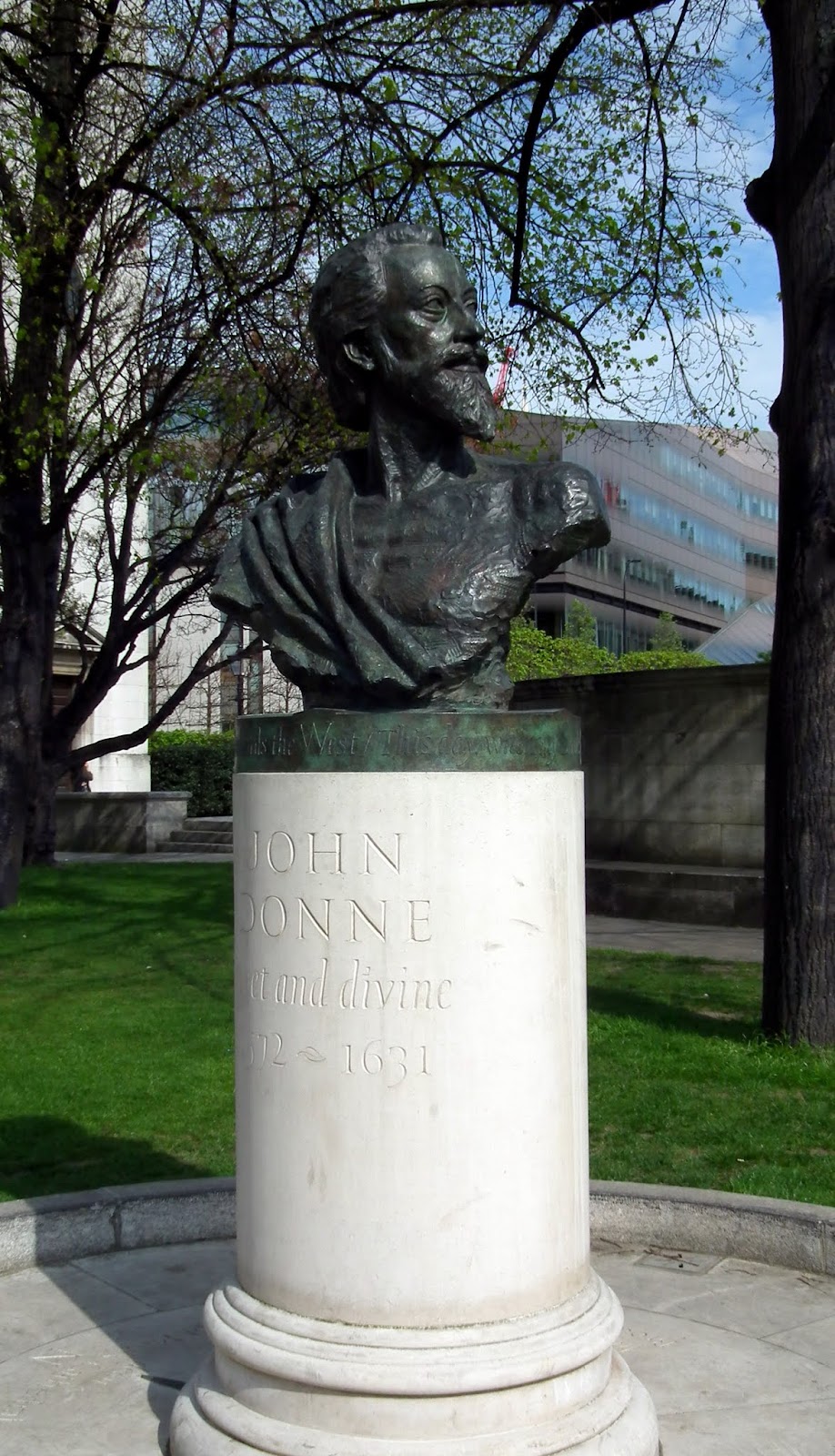
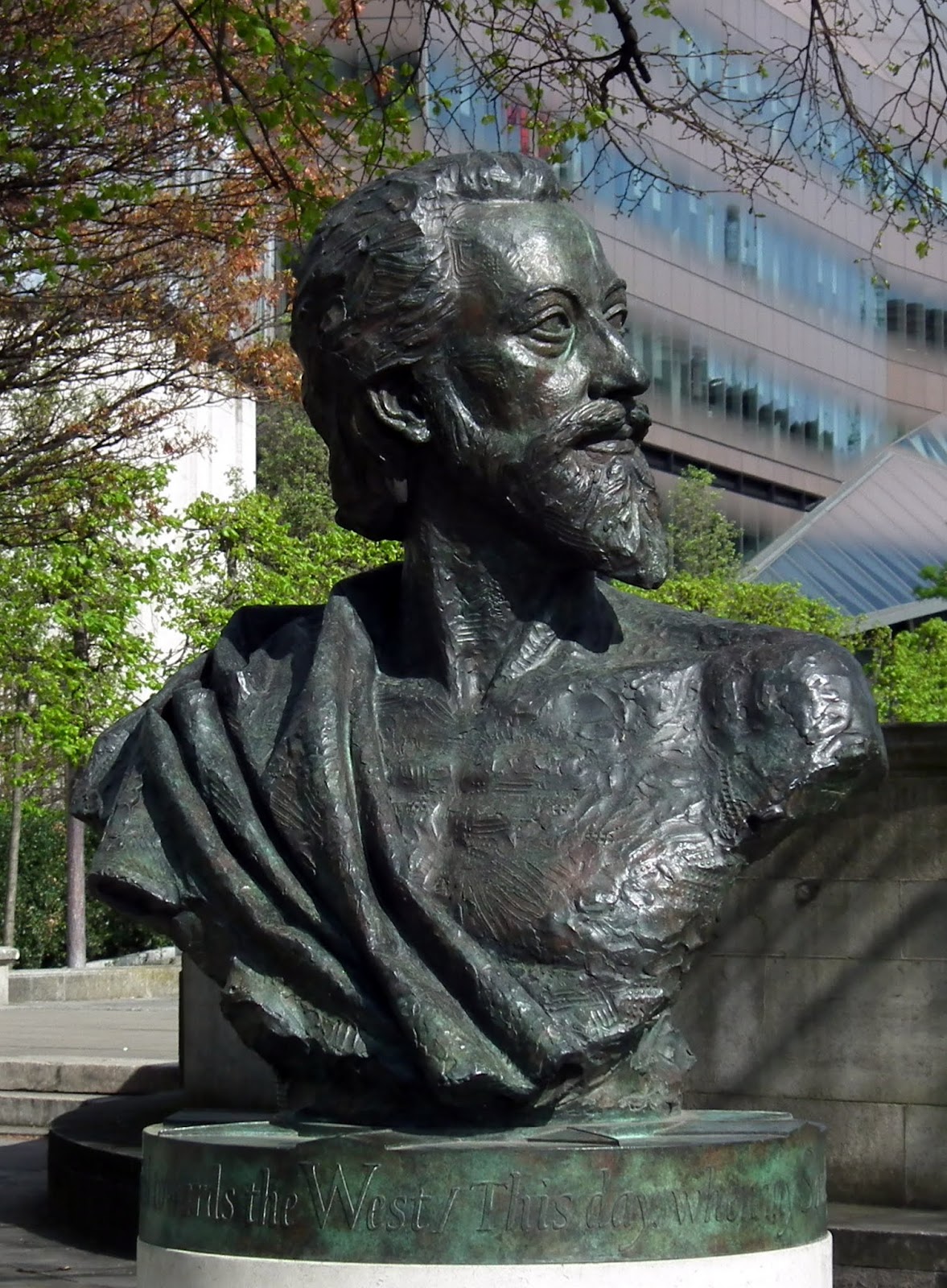
John Donne is commemorated by two statues in St Paul's, the famous image within the cathedral of his corpse in a winding sheet by Nicholas Stone, and now this one in the churchyard. It is by Nigel Boonham, cast in bronze in 2012.
The poet and churchman is shown facing west but looking south towards his birthplace close by in Bread Street. For Donne, east was the direction of the rising sun, Jerusalem and hope, while west was the way of decline and death, and beneath the bust is inscribed a line from Good Friday 1613, Riding Westward:
Hence is't, that I am carried towards the West,
This day, when my Soul's form bends to the East


Monday, 18 January 2016

193 Fleet Street EC4

George Attenborough and Son is one of the very few premises in London still bearing the name of the business that built it. It was erected in 1883 to the designs of Archer and Green, and is covered with sculpture by Houghton of Great Portland Street.
The main event, however, is the statue of Kaled, or Lara's Page, It is by Giuseppe Grandi, dating from 1872. Attenborough had a niche created specially for it over the front door of his shop.
Kaled is the page of Count Lara in Bryon's poetic story of a nobleman who returns to his ancestral lands to restore justice. He antagonises the neighbouring chieftains who attack and kill him. Kaled stays with his master to the end, when it is revealed he is in fact a woman. She goes mad.
The centre of the curved facade is marked with a couple of rather jolly winged lions holding a wrought iron structure that originally supported the three golden balls denoting Attenborough's other business as a pawnbroker. The motto beneath is the pawnbrokers' motto 'Sub Hoc [signo] floresco' - 'Under this sign I flourish'.
The windows below the lions are embellished with typically Victorian allegorical ladies representing the Arts and Trades, including painting, literature, spinning and beekeeping. One of them holds a caduceus in one hand and a cornucopia in the other, which mixes the messages rather.
The Chancery Lane windows have roundels depicting heroes of art from Michelangelo to Flaxman.
And for typografans, the lintels of the second storey windows have a florid decorated initial:

Wednesday, 23 December 2015

Temple Bar Memorial, Fleet Street EC4

The authority of the City of London extended beyond the old walls at many places, known as the Liberties. The entrances to the Liberties were controlled by guard points originally just a bar resting on two posts.
Gradually they became more elaborate and gained other functions such as the display of the heads of traitors and other malefactors.
The grandest bar of all was the one on the ceremonial route between the Palace of Westminster and St Pauls, which was regularly used by the monarch on national events. It became known as Temple Bar after the Templar's round church close by.
In 1670 a new bar was built in stone as part of the reconstruction programme after the Great Fire. In Victorian times however it was seen as gloomy reminder of times gone by and an obstruction to traffic. It was after much soul-searching removed stone by stone and ended up in the park of a grand house in Hertfordshire. In 2004 it was re-erected near to St Pauls.
Many felt the bar should not be replaced at all, especially as the road is particularly narrow at that point. Many proposals were made including one by George Street, who was designing the Royal Courts of Justice to the north of the site, who envisaged a gothic style bridge for judges to cross from the Temple. Other ideas included raising the old Temple Bar on a new arch, and making a traffic circus round it. The refusal of Child's Bank on the other side of the road to release land scuppered all these plans.
The design was eventually given to Horace Jones, architect of Tower Bridge, who created a slender column intended to allow traffic to flow more freely.
There is something about public sculpture that provokes Times letter writers to apoplexy, and this project was the subject of a particularly entertaining row. Everything from the continued traffic obstruction, lax organisation, shenanigans on the committee and, of course, the cost were gleefully attacked.
Particular vilification was directed at the figure on top, London's symbolic dragon as modeled by Charles Birch. For some reason many correspondents seem to think it is a griffin which of course it is not (a griffin has the body of a lion with the head and wings of an eagle: a dragon is a winged serpent.) It was booed by the crowd when the memorial was unveiled in 1880.
In today's eyes, however, the memorial is a typical piece of fussy, sentimental and overblown Victoriana.
The memorial is covered in carving. On the south side is a statue of Queen Victoria by her favourite sculptor, Joseph Boehm - she had dropped hints to the Lord Mayor, apparently. On the north side stands the Prince of Wales (later Edward VII), also by Boehm.
The slender east and west sides have portrait heads of the Lord Mayor, Sir Francis Truscott, and the Prince of Wales's eldest son Prince Albert Victor, known as Eddy. Eddy died of the 'flu in 1892 at the age of just 28. Lurid tales began to circulate painting him as a depraved epileptic moron, creating a rich legacy of TV documentaries on the 'secret shame of the Victorian royal family.'
The columns on the corners are elaborately carved with symbols of the arts (including busts of Homer and Chaucer), science, peace and war.
At ground level are three charming bronzes showing the Queen visiting the City.
The one on the south side shows Queen Victoria's Progress to the Guildhall in 1837, by Charles Mabey. The little lad kneeling at the door of the State Coach is the head Grecian of Christ's Hospital school, delivering a Loyal Address.
On the north side is Queen Victoria and the Prince and Princess of Wales going to St Paul's in 1872, by Charles Kelsey. They were giving thanks for the recovery of the Prince from an attack of typhus occasioned by the appalling state of the mains water supply at Sandringham.
On the east is my favourite, the one at the top of this post, showing the old Temple Bar disappearing behind curtains drawn by Time and Fortune. It is also by Mabey.

Sunday, 20 December 2015

Lamb Memorial, Giltspur Street EC1


Charles Lamb, the man who was Elia, went to school at Christ's Hospital when it was still housed in the old Greyfriars monastery in Newgate Street. He is portrayed in this memorial by Sir William Reynolds-Stephens in school uniform. Sir William also designed the aedicule in his typical magpie 'bit of this, bit of that' style.
The monument was made to celebrate the centenary of the essayist's death in 1834. It was originally mounted on the wall of Wren's Christchurch, next to the old school, but was transferred here in 1962 when the church was restored as a ruin after its near destruction in the blitz.
When the memorial was proposed, The Times said that a bust was the most appropriate form as it would avoid the need to show Lamb's "slight, spare figure, his spindle legs," in the words of a contemporary essay in the Gentleman's Magazine. His head, in contrast, was 'worthy of Aristotle' according to his friend Leigh Hunt.


Friday, 11 December 2015

SOE Memorial, Lambeth Palace Road SE1

The memorial to the Special Operations Executive is topped by a bust of the woman who epitomises the bravery, skill and suffering of the agents tasked to 'set Europe ablaze'. Most of them were tortured and executed.
Violette Szabo was one of the most admired by her comrades in arms, said to be fearless. She died in Ravensbruck aged just 23.
The sculpture is by Karen Newman, a no-nonsense realist who worked for over 20 years at Madame Tussaud's making waxworks of figures from Jimi Hendrix to the Duke of Edinburgh. Her Szabo is serious, determined and lovely.
Newman seems to have cornered the market in lady resistance fighters, having also portrayed Noor Inayat Khan and Nancy Wake.

Sunday, 6 December 2015

Kagyu Samye Dzong London, Spa Road SE16

Bermondsey Public Library, now a centre for Buddhist study and meditation, was built in 1890 to the designs of John Johnson ("Little to recommend it" - Pevsner).
It was opened by the banker, Liberal politician, polymath and philanthropist Sir John Lubbock (later Lord Avebury). In his speech he was quoted as saying: ‘It was rather sad to think that when people spoke of a public-house they always thought of a place for the sale of drink. He was glad that all through London public houses were now rising up for the supply – not of alcohol, but of literature.’ 
Which is rather a contrast with his famous remark: "Earth and sky, woods and fields, lakes and rivers, the mountain and the sea, are excellent schoolmasters, and teach some of us more than we can ever learn from books."
But I digress.
The building is scattered with the usual vaguely aspirational sculpture you find on Victorian libraries. The entrance is marked by a mansard-roofed tower with allegorical figures. The woman on the left holds a book, so probably represents modern learning, whereas the bearded gent on the right holds a scroll and has an owl at his feet so I imagine exemplifies classical knowledge.
The coat of arms, a lion with a bishop's crozier and mitre, is of Bermondsey Abbey, hijacked by the Borough Council.
The keystones over the windows have portrait heads of suitably reverential figures including Shakespeare, Milton and Homer. The other two are so worn they look like nothing more than a pair of stockinged robbers holding up the local Coop. One of them has a necktie and coat so must be fairly modern - perhaps Keats or Byron. The other is female, judging by the necklace. Jane Austen, perhaps?

Friday, 4 December 2015

Mile End Waste, Mile End Road E1

William Booth, founder of the Salvation Army, began his mission as an independent preacher in 1865 on a rough area of common land known as Mile End Wastes, where he set up a tent and preached a gospel of forgiveness for all.
Today, Booth is commemorated by two statues in locality, but it is easy to forget that at the time he was only one of many - about 500 charities were working to alleviate poverty and eradicate sin in the East End. It was Booth's dynamism and his brilliant realisation that military ideas of esprit de corps could be adapted for God's purposes that set him apart.
The bronze bust, erected in 1927 opposite the Blind Beggar where he famously preached, shows Booth in full fig as General, complete with gold braid, epaulettes and insignia of office. It is by George Edward Wade and was cast at the Morris Art Bronze Foundry.
Wade, the son of a clergyman, was a self-taught sculptor who rejected experiment and just went for a good likeness. As a gentleman and a reliable pair of hands, he built up a lucrative practice immortalising the upper classes from Queen Victoria and Earl Haig down.
The Morris Art Foundry, one of the ancestors of today's Morris Singer Bronze Foundry, was founded in Lambeth by William Morris in 1921. No, not that William Morris, though apparently our Bill made no strenuous efforts to dispel the assumption that the firm had connections to the great designer, writer and socialist.

Wednesday, 2 December 2015

Millbank SW1

Enzo Plazzotta based his statue Jete on David Wall, famous as creator of the role of Crown Prince Rudolf in Mayerling, the youngest ever Siegfried in Swan Lake and as frequent partner to Margot Fonteyn. He was also the youngest ever Principal Dancer at the Royal Ballet.
The statue was created in 1975 when Wall was only 29 and is a typical subject for Plazzotta, who also created images of Fonteyn, Nadia Nerina, and Antony Dowell.
Plazzotta was born near Venice and studied in Milan until the outbreak of war, when he became a partisan leader around Lake Maggiore. When peace came, he was commissioned by the Italian Committee of Liberation to make a pair of statuettes for presentation to the British Special Forces to commemorate their successful partnership. He came to London to present them personally, liked the place and stayed.
His commitment to classicism brought him derision from the modernist art establishment in the swinging sixties, naturally, especially his fascination with freezing fast moving subjects in bronze. He had the last laugh, however, discovering a lucrative market modelling racehorses for rich owners.

Tuesday, 1 December 2015

Pimlico Garden and Shrubbery, SW1

The Helmsman stands motionless at the stern of his boat, holding the tiller. He is completely nude except for an Evil Empire Style helmet.
The work, cast in bronze, was made by Andre Wallace and installed in 1998. It was paid for by Berkeley Homes, the quid pro quo for planning permission for a nearby housing development. It won an open competition judged, appropriately, by local councillors, the developers, local people and the Lord Mayor of Westminster.